3.3 Miles of Mythos and Grandeur The Canadian Pacific Railway as art in Glacier National Park, BC
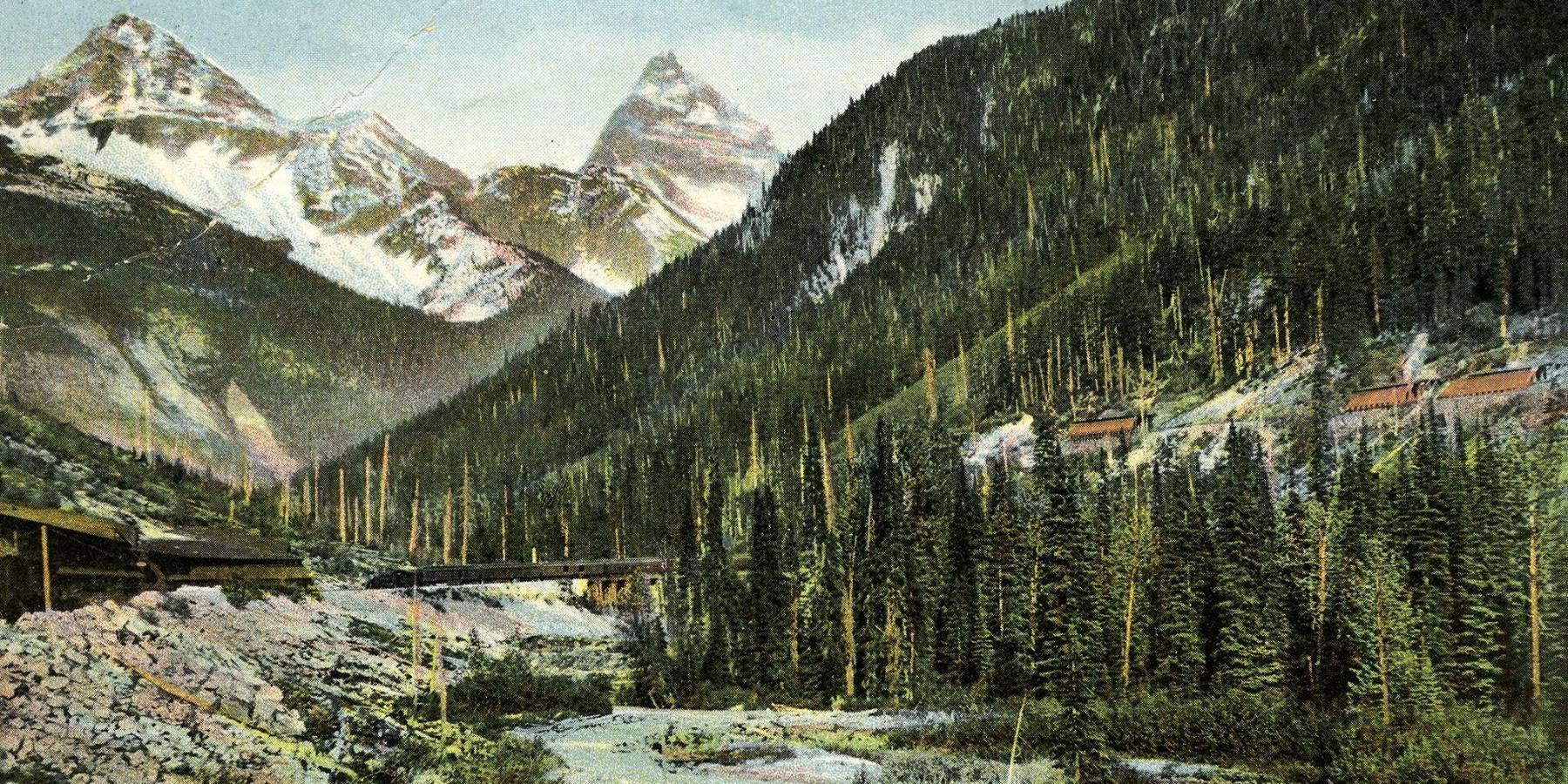
There is a striking stretch of former railway in Canada that merits closer attention. It is no longer visible from a passing train, but much of it survives as a walking trail in British Columbia’s Glacier National Park (sharing a name, but not an identity, with the park in Montana). More than a century ago, several miles of this former Canadian Pacific Railway (CPR; now CPKC) main line were widely admired for both their scenic beauty and bold engineering. Although later bypassed by rerouting, these features endure because modern traffic now passes beneath the Selkirk Mountains via two long tunnels. In 2016 the Macdonald Tunnel was inducted into the North America Railway Hall of Fame.
This article, however, is concerned less with tunnelling than with art, beauty, and representation.
This essay first appeared in Railroad Heritage, published by the Center for Railroad Photography & Art. I encourage you to visit their new website when you’re done reading.
From the outset—completion came in 1885—CPR management recognised the western mountains as valuable assets. Vice-President (later President) Cornelius Van Horne famously observed: “If we can’t export the scenery, we’ll import the tourists.” The company acted accordingly. In the mountains, art, landscape, and industry converged as the CPR actively sponsored artists and photographers to transform scenery into international spectacle—and profit.
...the CPR directly supported painters and photographers [...] ensuring that both railway and landscape were rendered in iconic form.
The idea was not entirely new. The opening of the American West had already been documented by accomplished artists whose work fuelled interest in both the artists themselves and the land they depicted. Van Horne went further. Whereas American railways largely relied on independent practitioners, the CPR directly supported painters and photographers, even providing darkroom facilities, ensuring that both railway and landscape were rendered in iconic form.
The policy was unprecedented in scale and generosity. Whether artists felt compelled to include the railway itself within their compositions—and whether its presence enhanced or compromised the landscape—remains a central question explored here.
The work done by several artists, whose pictures in oil and water-colours were shown us, proved that this is a region surprisingly rich in material for study from the artist’s standpoint. The works of two Toronto artists, Messrs. Martin and Bell-Smith, both members of the Canadian Academy, are especially commendable to the public. These gentlemen, spending weeks in the mountains, are doing for the Selkirks what Bierstadt did for the Sierra Nevadas. This is the most satisfactory resort for the artist, the photographer, the lover of nature, the seeker for the grand and beautiful. On no other transcontinental railway can be found crowded together such an aggregation of scenic grandeur.
It is worth noting that the German-American painter Albert Bierstadt worked in Canada’s Glacier Park in 1890, though none of his Canadian paintings remain in the country. Other early artists to enter the Canadian Rockies and Selkirks in the late 1880s—John Fraser, Lucius O’Brien, William Brymner, and Thomas Mower Martin—were influenced by European traditions and the American Sublime movement. Working primarily in watercolour, they produced romantic, picturesque views that conveyed the immensity of the landscape and helped popularise the West among travellers and settlers.
The sublime is fundamentally an emotional response to nature: an encounter with something vast, awe-inspiring, or even unsettling, that challenges human scale and perception. Artists evoking it employ composition, colour, and perspective to draw viewers into such experiences. Beyond aesthetics, the sublime was also used to comment on accelerating technological change and its societal impact.
The sublime is fundamentally an emotional response to nature...
Van Horne understood this. A capable sketcher himself, he maintained close friendships with professional artists and exerted direct influence on Canadian art. He was even recorded as instructing an artist to heighten the view of Mount Stephen at Field, BC—seeking greater awe in the scene.
Each artist discussed here was drawn to the Glacier area just below the summit of Rogers Pass. On the western slope, a horseshoe curve and a large S-bend were engineered to reduce gradients to manageable levels. Completion of the Connaught Tunnel in 1916 rendered this higher alignment—known as the Loops—obsolete. Beyond their engineering importance, the Loops, with their trestles and snowsheds, formed a compelling visual spectacle, compressed into just 3.3 miles of standard-gauge track.
Map of Glacier National Park
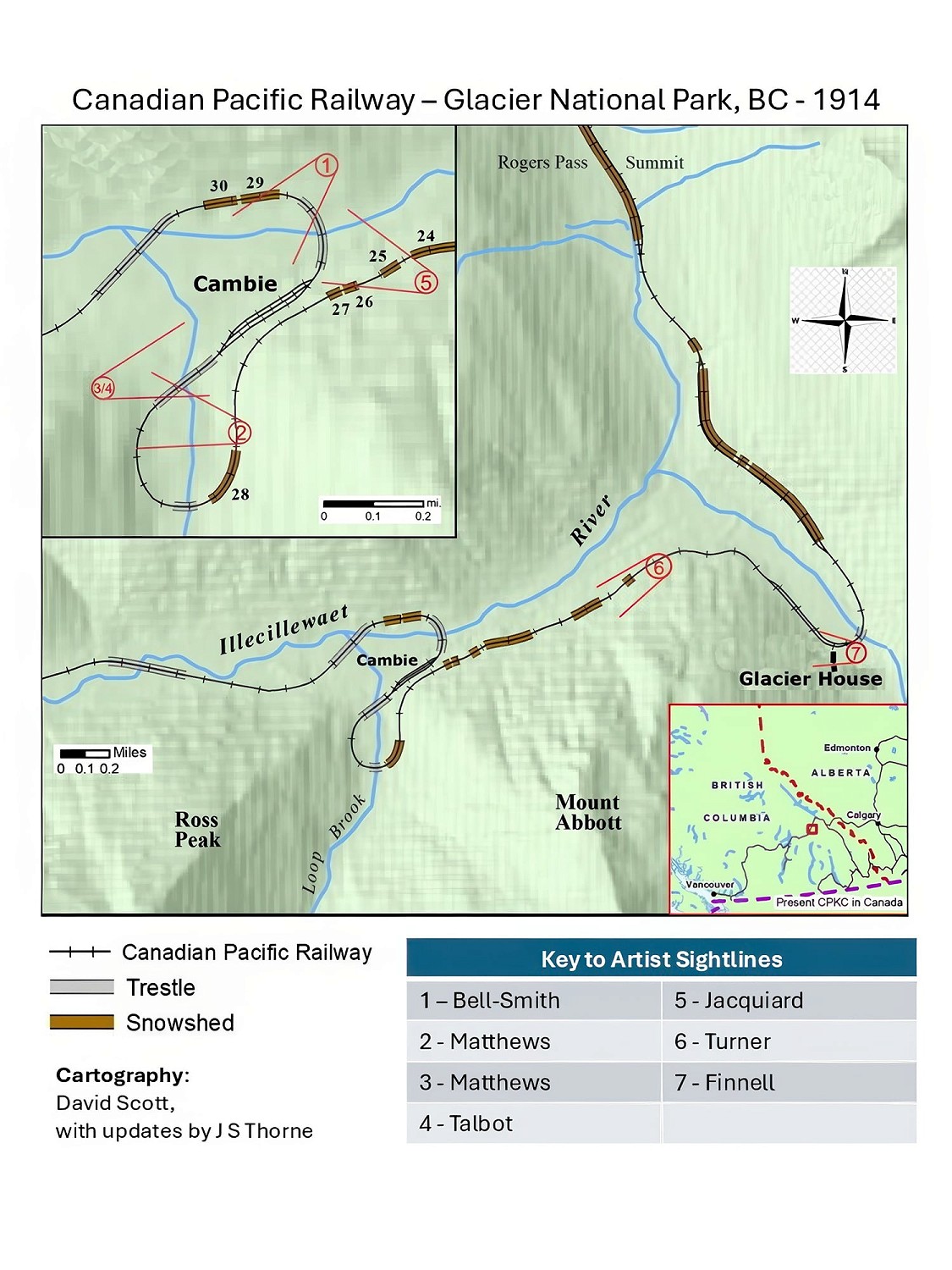
The Loops as they looked in 1914, with sightlines used by six artists over the years. Compare these with the matching scenes by photographers.
Glacier House
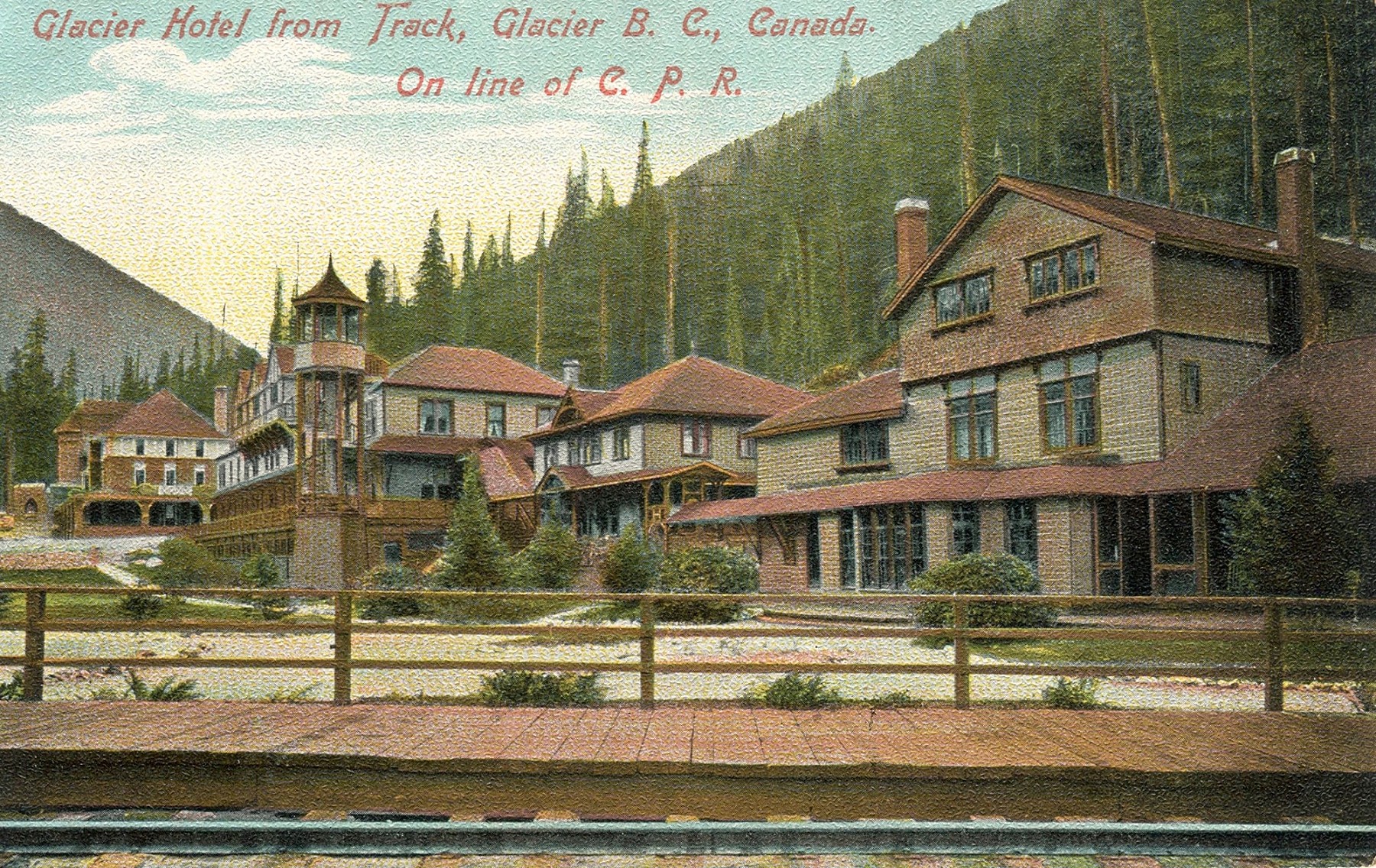
Hand-tinted postcard of Glacier House as it appeared to disembarking passengers about 1905. Guest amenities included a high-elevation teahouse, hiking trails, Swiss mountain guides, and ponies for excursions to the nearby glacier. The hotel’s homey atmosphere and informal hospitality charmed many guests to return year after year.
Glacier House, the CPR’s mountain hotel, was frequently praised. It provided a refined outpost amid the rugged Selkirks and stood near the tongue of the Illecillewaet Glacier (then known as the Great Glacier), within walking distance for guests. From the hotel, trails led into surrounding valleys and summits.
Artists classified as “special guests” were given access to velocipedes to reach their working locations downhill at the Loops, passing through eight snowsheds and over four watercourses. Watercolours were favoured for portability, though larger works—both watercolour and oil—were often completed later in studio. As familiarity with the terrain increased, some artists incorporated details derived from glass-plate photographs, refining compositions after returning east.
Through these works, one can trace not only evolving artistic approaches but also the influence of the CPR’s patronage on Canada’s emerging national identity. Although corporate in origin, artists such as Frederick Talbot, William Notman, Marmaduke Matthews, and Frederic Bell-Smith helped establish a recognisable Canadian school of landscape art. Today Glacier Park remains open to interpretation, though ubiquitous photography has largely replaced the individual vision of painters.
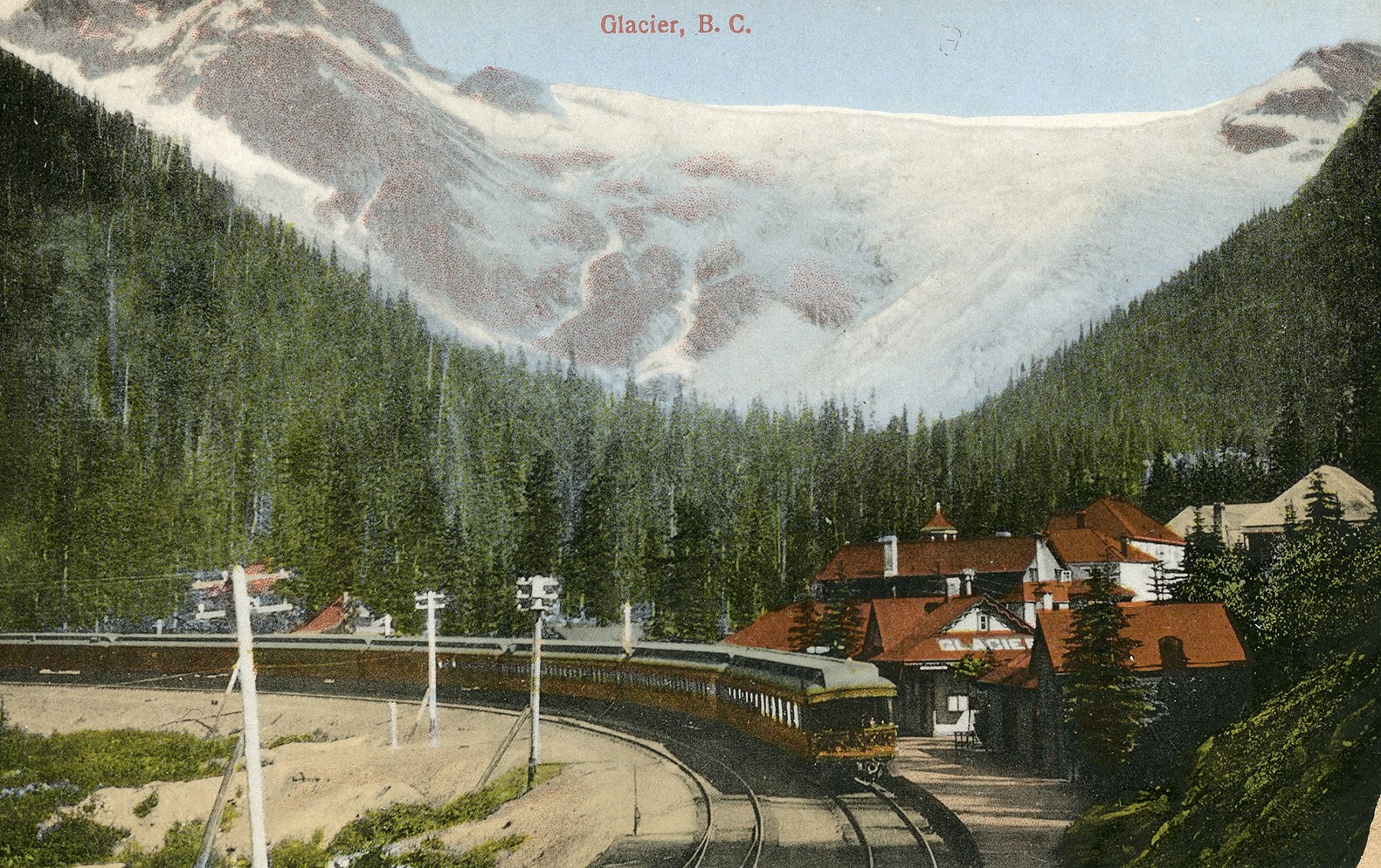
Hand-tinted postcard of the Atlantic Express departing Glacier House for Montréal by SH Baker, a local photographer. The hotel served as a meal stop, sparing trains from hauling heavy dining cars over steep Rogers Pass. This track was removed in 1917 after the Connaught Tunnel was completed the previous year. Declining visitation led to the hotel's closure in 1925.
Frederic Marlett Bell-Smith
(1846–1923)
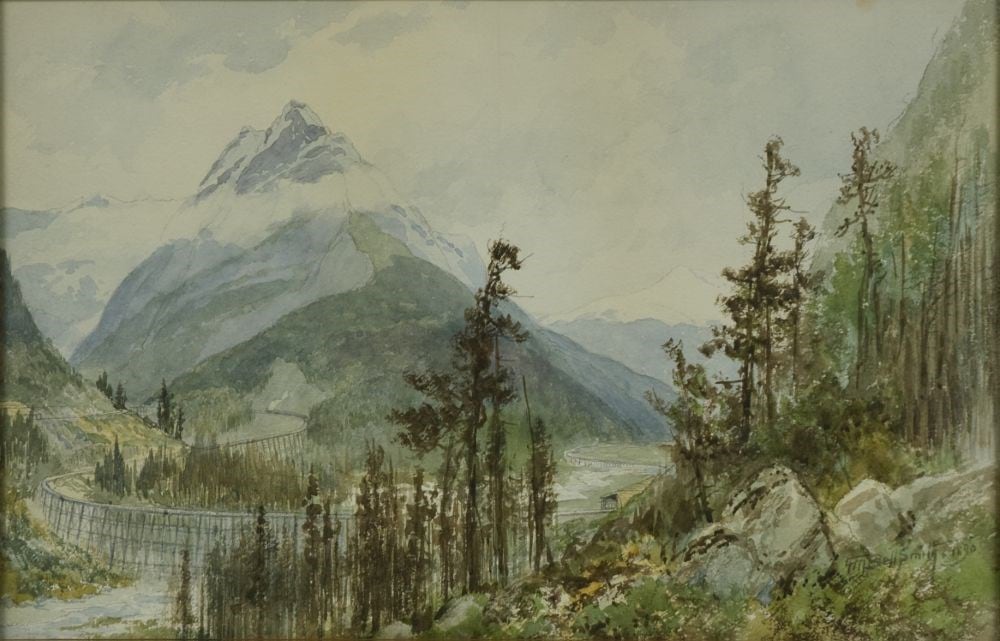
Trestles at the Loop, 1890, by FM Bell-Smith. Viewing southwest from position ① on the map inset. From the collection of the Whyte Museum of the Canadian Rockies, Banff, AB. Reproduced with permission.
Bell-Smith first travelled west in 1886 on a free CPR pass arranged by Van Horne. He was especially drawn to the Lake Louise area, where the railway had established modest accommodation. Whether artists paid for hotel stays or compensated the CPR with paintings is unknown. Given the early fires that destroyed both the Banff Springs Hotel and the Château Lake Louise, any such works may have been lost.
Born in England, Bell-Smith came to Canada in 1867 after formal training. His work was well regarded in London and Paris, and Queen Victoria sat for him in 1895. Of 138 Bell-Smith works held in Canadian museums, only ten are neither oil nor watercolour.
In Trestles at the Loop, Ross Peak is enveloped in mist while a distant train climbs its flank. His easel position is marked ① on the map inset. Bell-Smith’s western landscapes earned critical praise, with one reviewer calling the Glacier House area “the Canadian country of the gods”. His work conveyed not only spectacle but myth, reinforcing the idea of the “Great Lone Land”.
Compare the locomotive’s smoke plume here with that in the following painting by Marmaduke Matthews; both artists were drawn to this vantage point beneath Ross Peak.
Good-bye to the Glacier and down the easy grade of the Pass we go on passenger No. 1, swinging under Ross Peak, over the far-famed Loops, through the snow sheds…
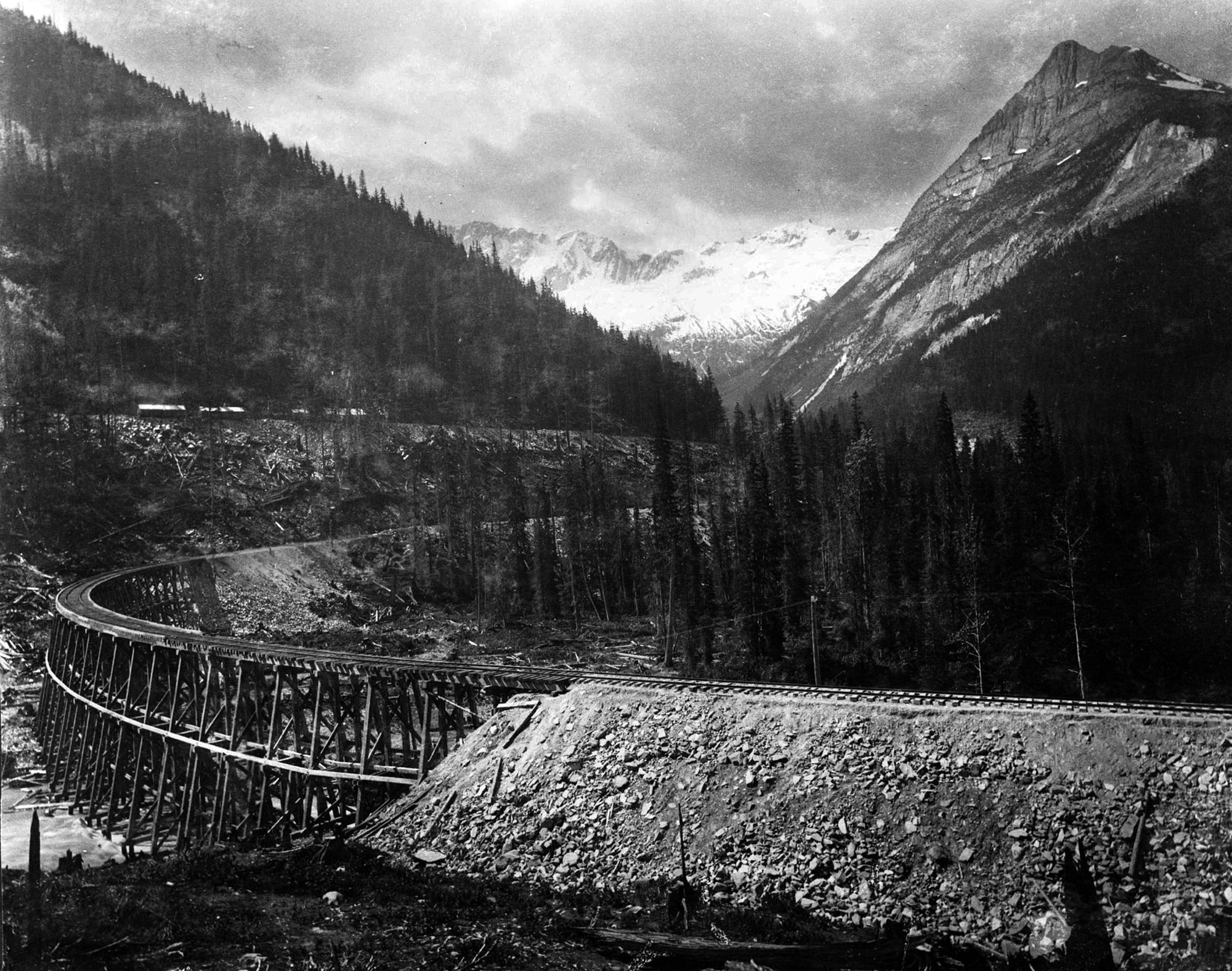
This 1886 image was exposed from the opposite side of the Illecillewaet Valley from that of the young walker (see Notman 1 photo). This long, curving trestle is being infilled from both ends. Bell-Smith, in contrast, chose a higher perspective to emphasize the trestle's expanse over its intricate details. Photo by Oliver B Buell, courtesy Glenbow Archives NA-4140-33.
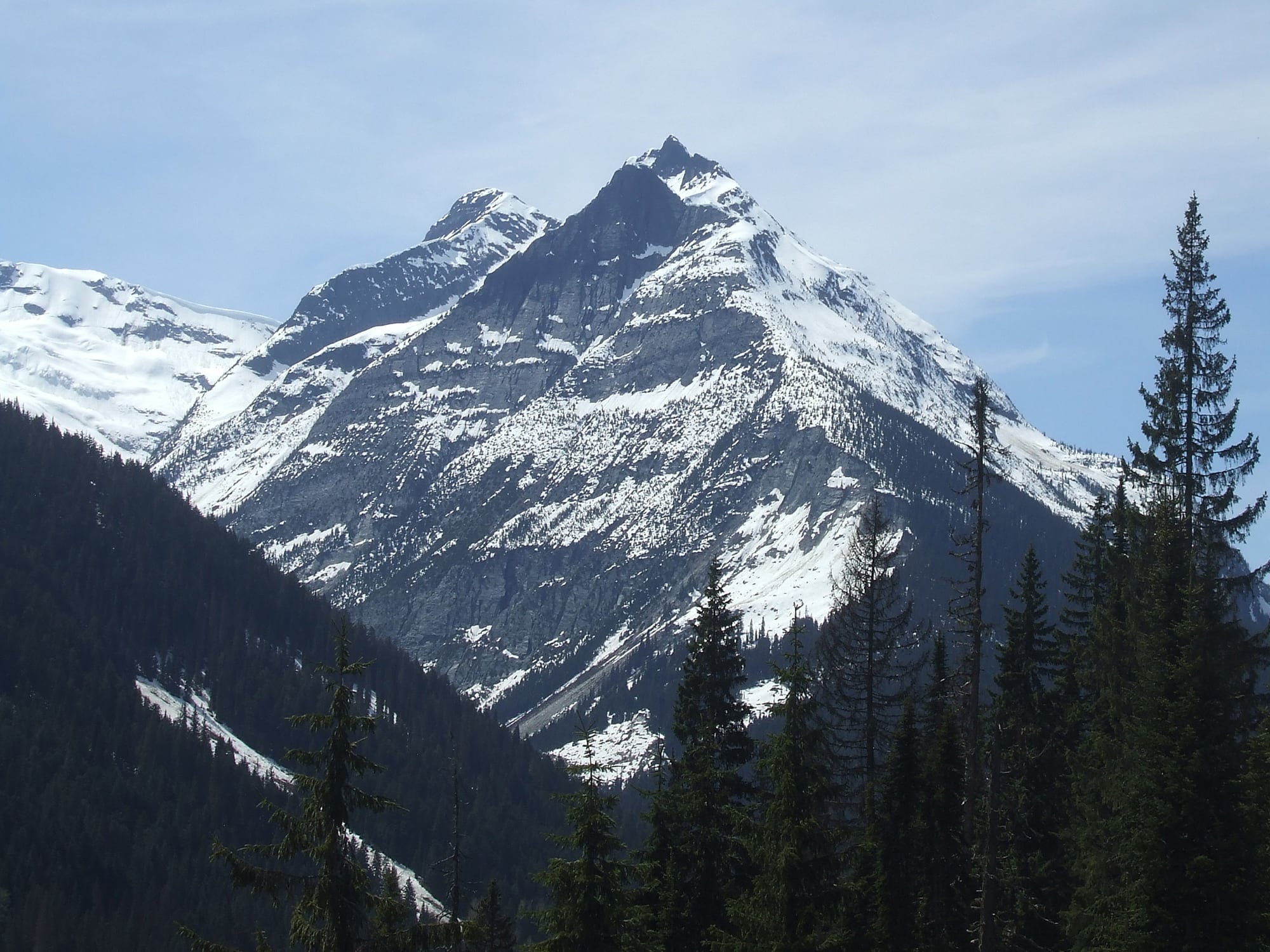
Ross Peak. Photo © TW Parkin.
Marmaduke Matthews
(1837–1913)
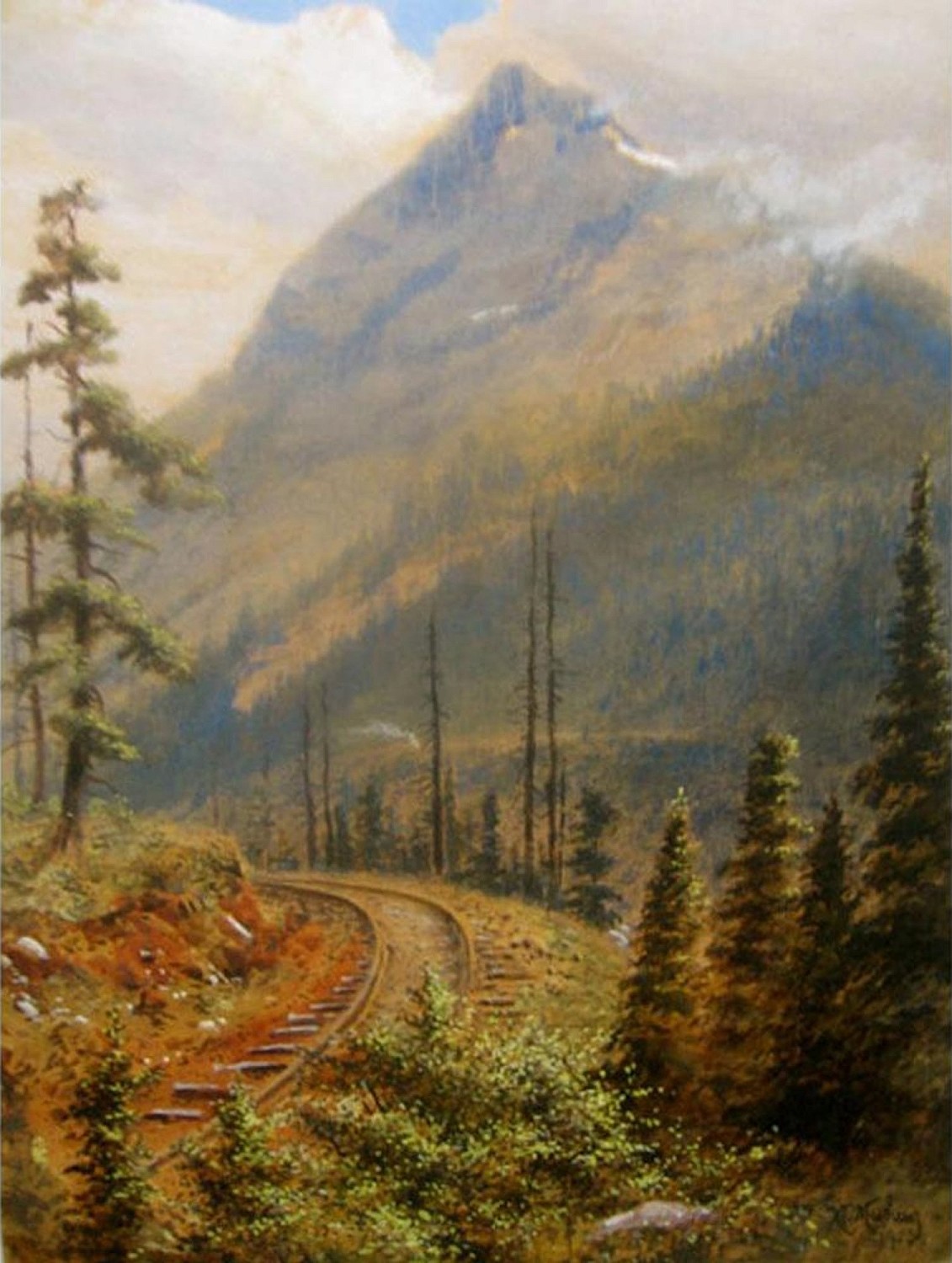
This scene by M Matthews closely matches the viewpoint of WM Notman, the Montréal photographer commissioned by the CPR years earlier (see position ② on the map). Notably, some features are rendered realistically, while others have been altered—Matthews' reasoning remains unknown. This painting is dated 1904, but the artist never titled it.
This second portrayal of the railway on Ross Peak allows comparison between writer Talbot, photographer Notman, and painter Matthews. Matthews painted from position ② on the map, combining oil and watercolour. Over time, acidic paper and light exposure caused fading; the present reproduction was digitally adjusted, with permission, to approximate its original appearance.
Matthews worked in a realistic idiom comparable to his contemporaries. Best known for landscapes, he first travelled west in 1887 on Lucius O’Brien’s recommendation and returned frequently. Though his work brought recognition, it rarely brought financial reward; Mountain Landscape was offered by a Toronto gallery in 2024 for $800.
The lower trestle in the accompanying Notman photograph appears elsewhere in this article. Ross Peak commemorates James Ross, engineer in charge of the 1884 construction who devised the Loops. Like Van Horne, Ross was an avid art collector.
Matthews likely sketched on site—only 2.5 miles downhill from Glacier House—though many artists completed work later in studio. This may explain inconsistencies noted by critics, and the fleeting detail of the train’s smoke may not have been captured on location.
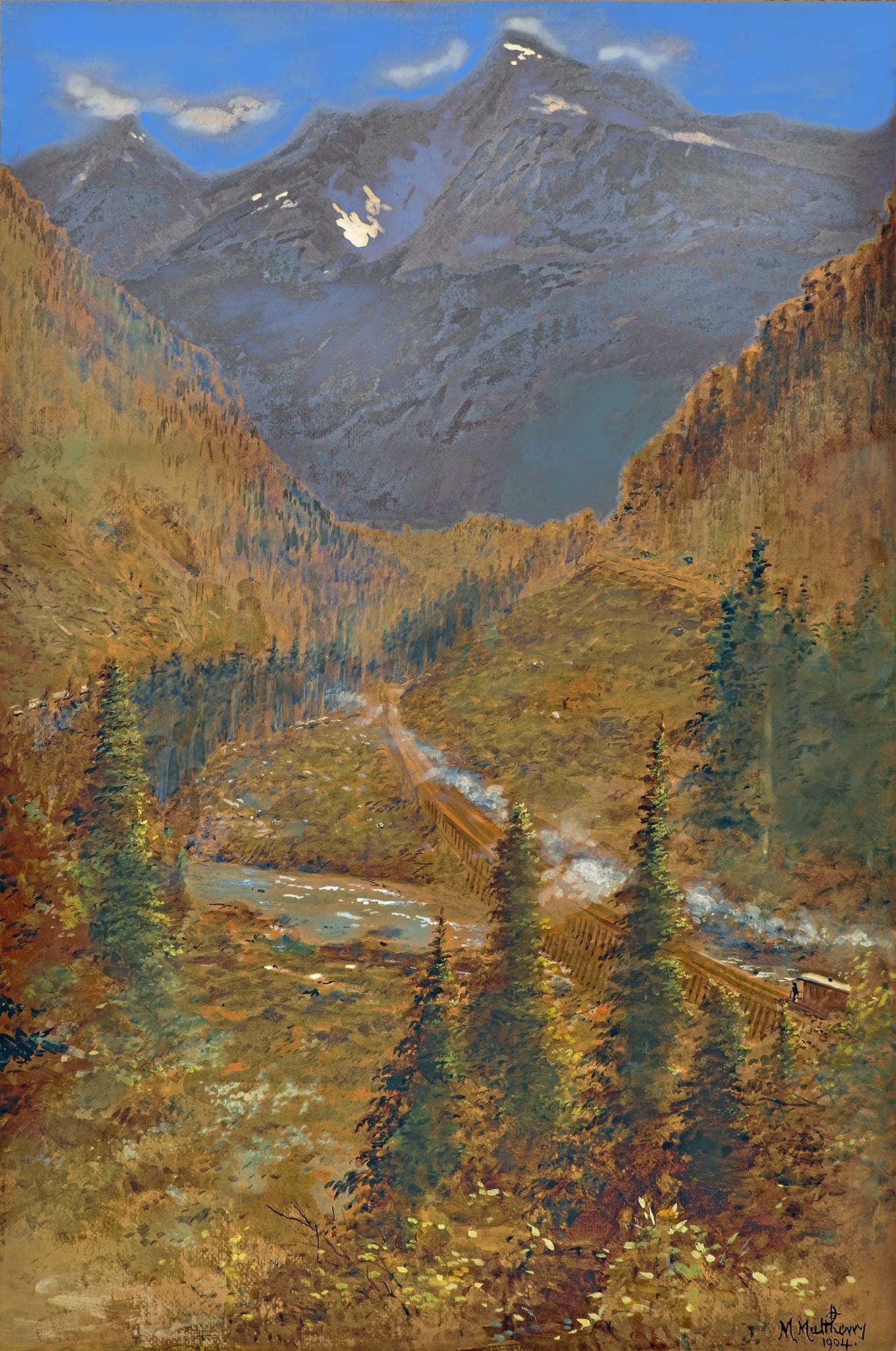
‘Winding Railways in a Mountain Vista’, also from 1904 by M Matthews. This is the view from vantage point ③ within the map inset. Many photographers chose this position because it was possible to show as many as four tracks as the CPR climbed toward Rogers Pass. Original now in a private collection. Photo courtesy of ArtValue.ca.
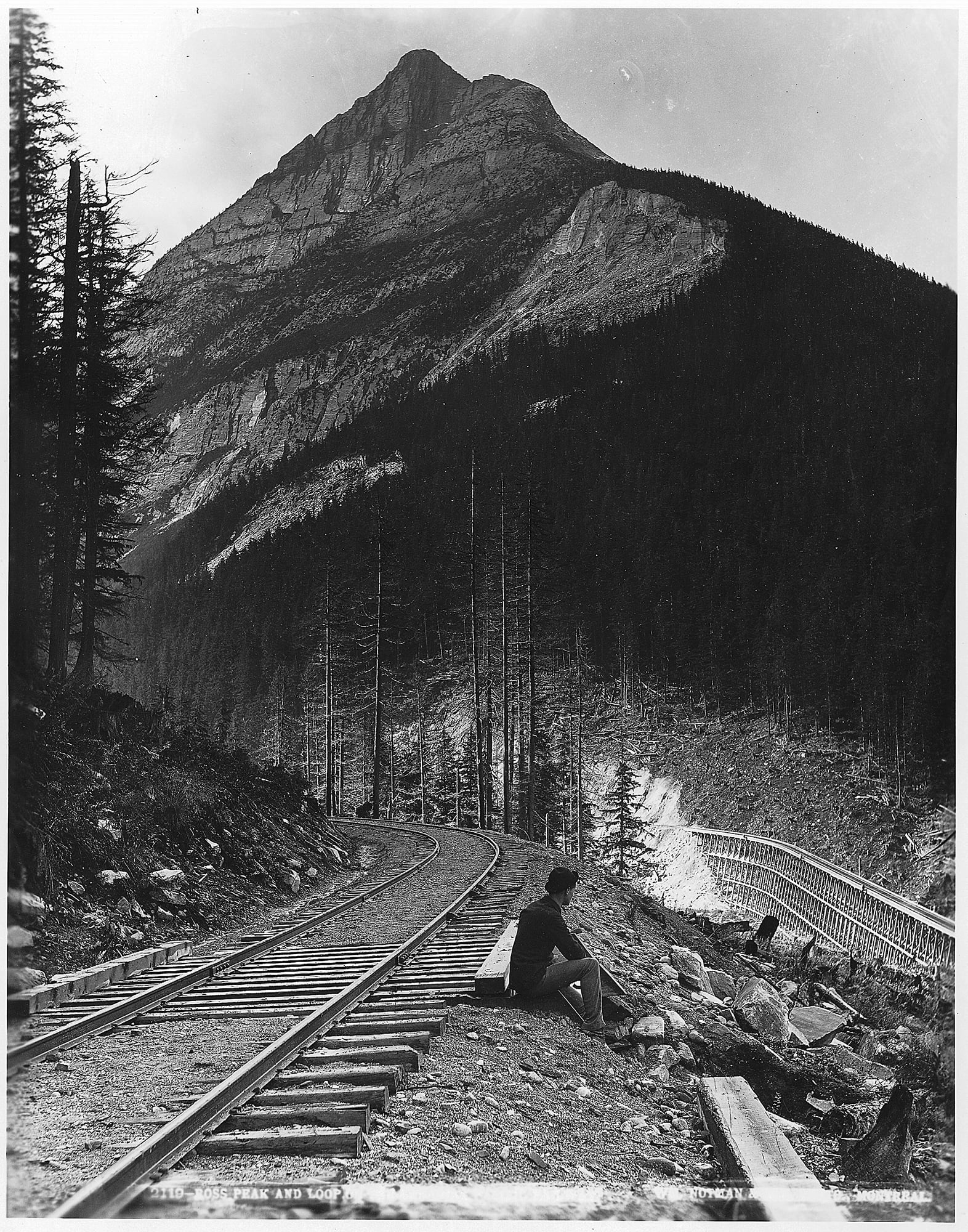
Notman 1: In 1889, photographer WM Notman captured this view from the same spot 19 years before painter Matthews. The track bending to the left leads into the glacier-carved valley of Loop Brook, now part of Glacier National Park. Today, this former railbed serves as an interpretive trail. Photo courtesy McCord Stewart Museum, Montréal, VIEW-2119.
Painted the same year, this second view retains its original colours. Ross Peak dominates the scene, a rendering that likely appealed to Van Horne. Nineteen years earlier, William McFarlane Notman photographed this same location. The track curves into the Loop Brook valley, descending 0.5 mile at 2.2 per cent grade. The route remains walkable today with interpretive signage.
Note how Matthews adjusted the railway’s alignment on the far slope; the smoke is carefully placed to confirm a locomotive rather than a campfire. Matthews’ western work is held in the BC Provincial Archives, the Glenbow Museum, the Royal Ontario Museum, and the National Gallery of Canada.
Frederick A Talbot
(1880–1924)
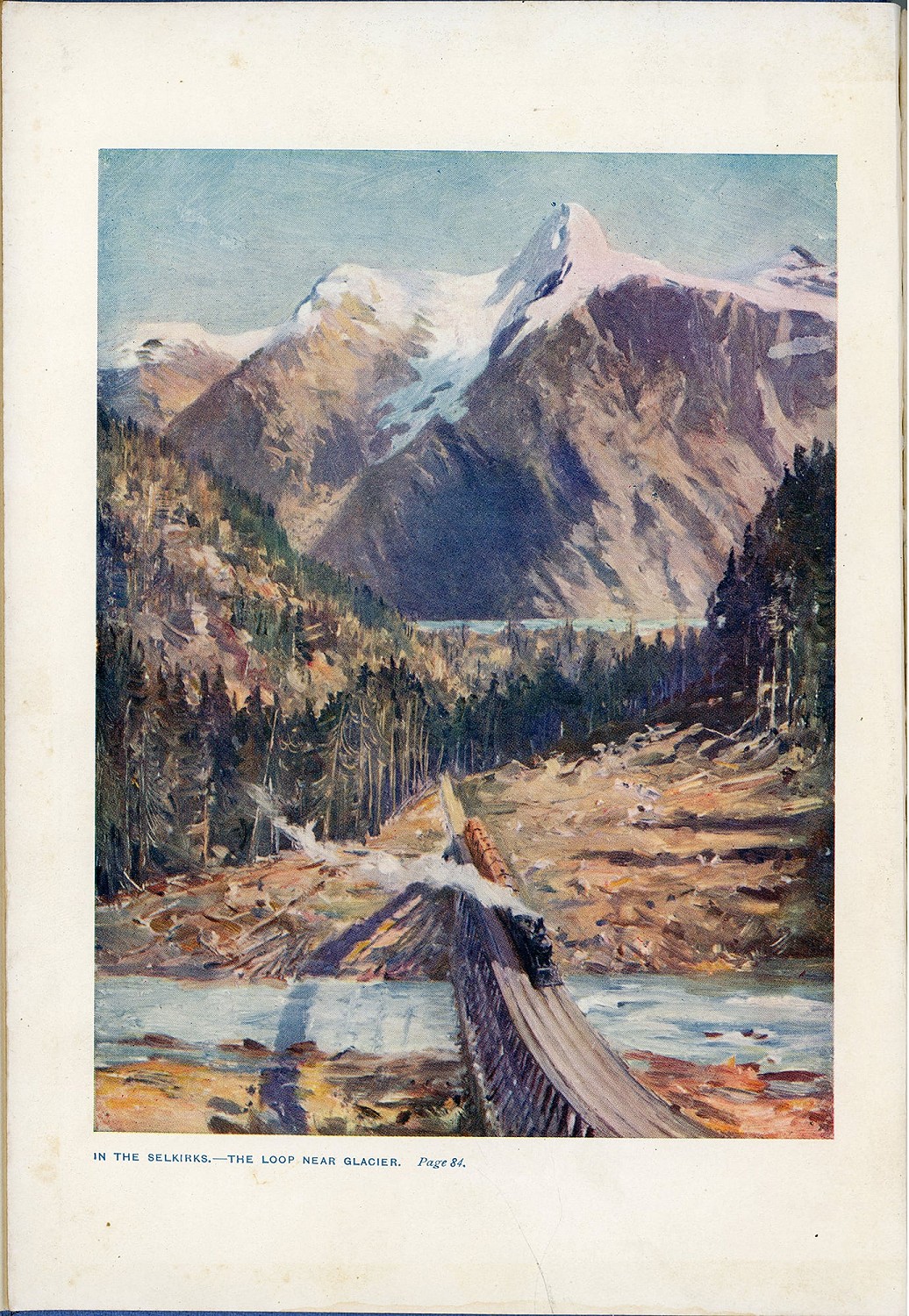
FA Talbot painted ‘In The Selkirks — The Loop Near Glacier’ around 1914 incorporating it within his illustrated CPR primer Peeps at Great Railways: The Canadian Pacific Railway published in London, England, 1915. Note how he simplifies the windings of the track as compared to the Notman 2 photographic view from this same vantage point (position ④ on the map inset).
Talbot, now largely forgotten as an artist, worked for the CPR after Van Horne’s retirement. Encouraged by Rudyard Kipling, he enjoyed a brief but productive career as author, publicist, and artist.
His watercolour featuring the former flagstop Cambie illustrates In the Selkirks, a travelogue notable for avoiding conventional sublime imagery. Talbot was unusual in depicting trains in watercolour, a technically demanding choice.
Although prolific as a writer—author of 25 books on science and travel—his artwork is poorly documented. No auction records or exhibition histories are known. His primary reputation as an author may have eclipsed his visual work.
Talbot stayed at Glacier House while researching. His painting shows the Loop Brook trestle before its 1906 reconstruction, though he may have relied on Notman’s 1887 photograph. If so, he mistakenly rendered the trestle as double-tracked.
He described the snowsheds in detail, though he did not illustrate them:
When special dangers arise… snow-sheds were built over the railway…
In 1924 Talbot was sent west to prepare for the Prince of Wales’s transcontinental journey. He contracted pneumonia in Calgary and died aged 44.
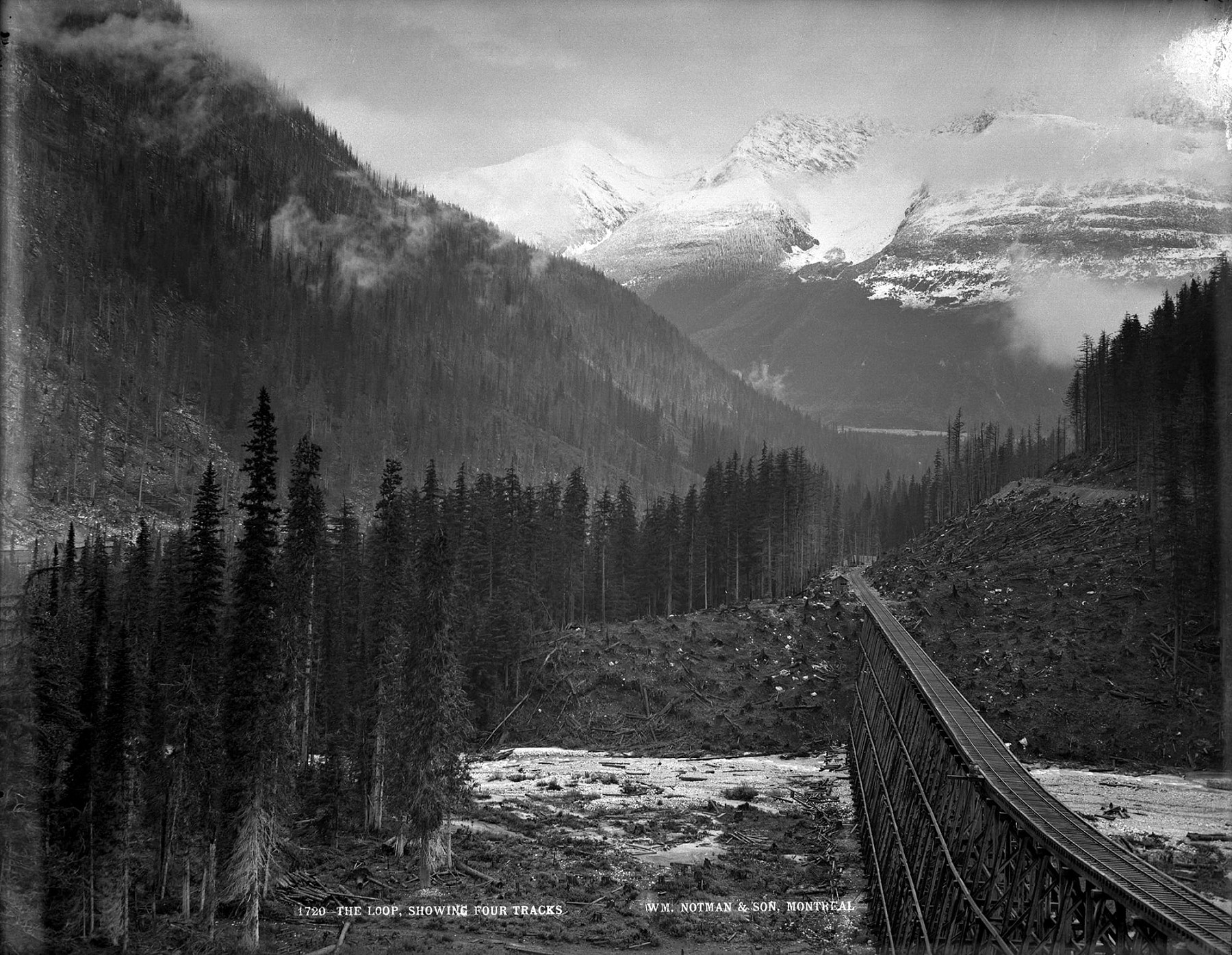
Notman 2: Titled “The Great Loop showing four tracks’, 1887, this frequently used vantage point captures the CPR’s winding ascent over the west side of Rogers Pass. From left to right, from bottom to height, the eastbound track reveals its route four times. Photo by WM Notman, McCord Stewart Museum, Montréal, VIEW-1720.
Max Jacquiard
(1934–2022)
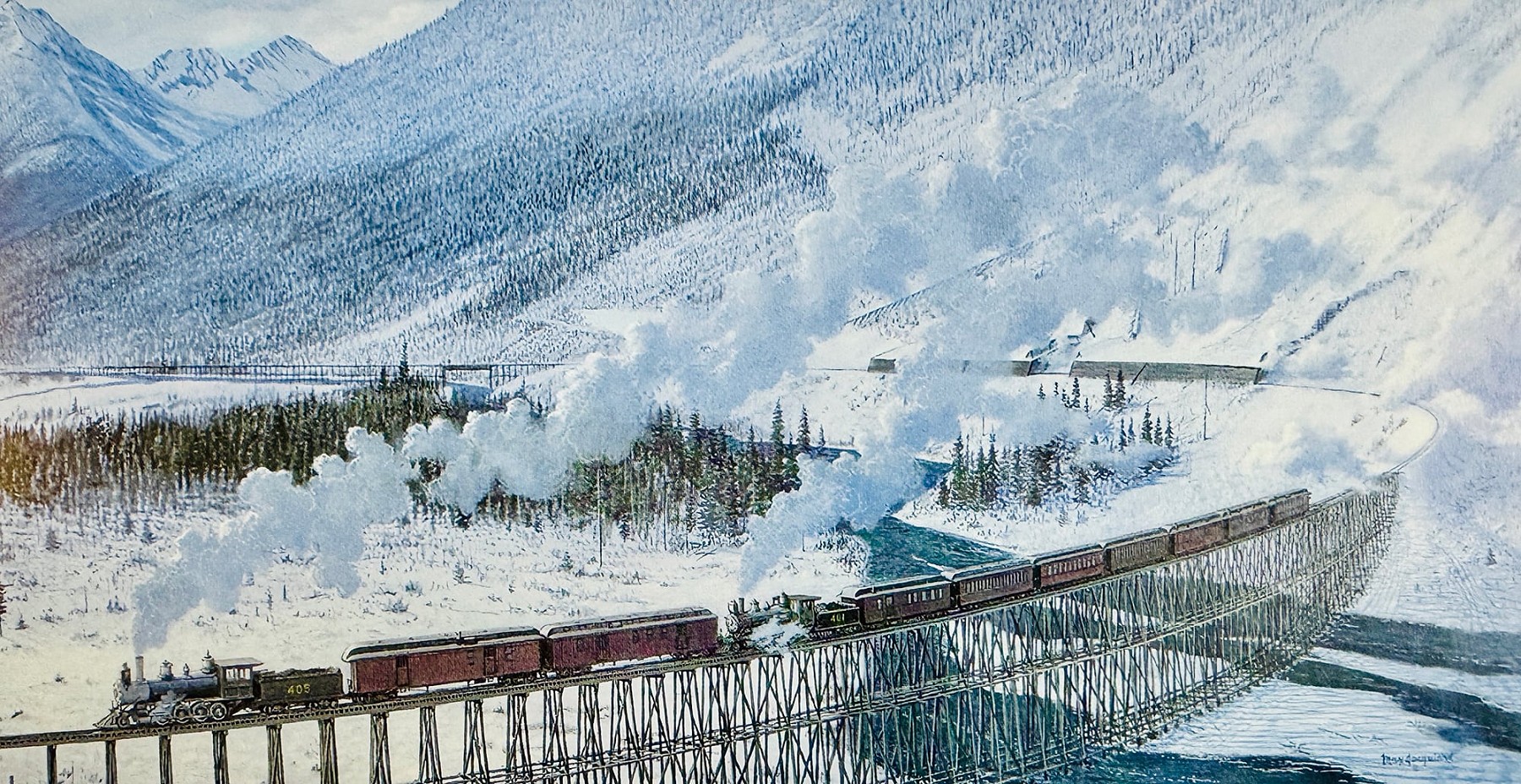
M Jacquiard depicts the Loop crossing at Illecillewaet River. Two Consolidation locomotives are hauling an eastbound passenger train toward Rogers Pass. Their position can be calculated from this article’s map. As an example of Jacquiard’s knack for accuracy, note how two baggage cars separate the engines to spread weight on the trestle bents. This scene’s period is interpreted as the 1890s, one rarely regarded by Jacquiard.
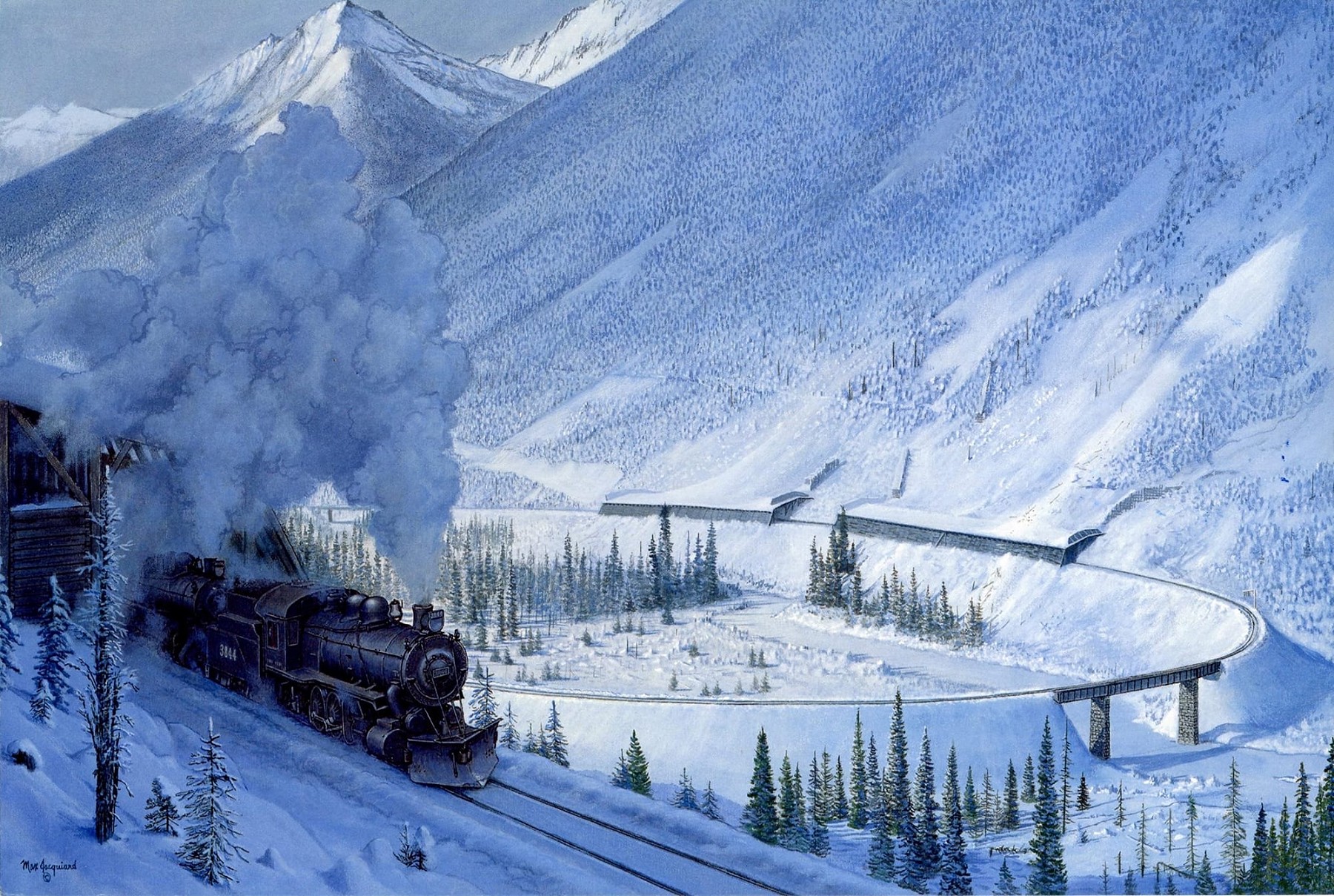
In this scene, circa 1914, Jacquiard shows the subsequent upgrading of the Loops in an early winter scene from a position evidently inspired by Notman photo 3/position ⑤ on the map insert. Since 1884, the vulnerable trestle has been buried and the watercourse is now spanned by more enduring stone and steel. These works were largely obliterated by highway construction in the 1960s. This limited edition print released in 2005.
Set in 1914, this winter scene typifies Jacquiard’s commitment to historical accuracy. From 1981 onward he produced over 400 paintings, mostly 20th-century western Canadian scenes, now largely in private collections.
Two traits define his work: human figures are subordinate to machines and mountains, and perspectives often derive from imagined or inaccessible vantage points—achieved accurately before drone photography. His reference library was extensive, and site visits frequent.
The Loop Brook and Illecillewaet River trestles are shown with one minor error: the latter is depicted on stone rather than concrete piers. Given the difficulty of reaching the site through dense rainforest, the inaccuracy is understandable.
Jacquiard was inducted into the Canadian Railway Hall of Fame in 2006.
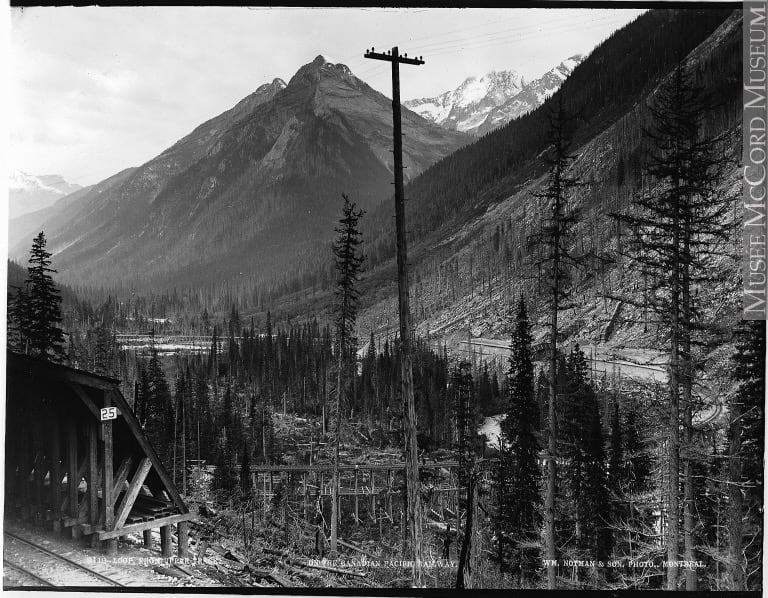
Notman 3: Exposed in 1889, this Notman view titled ‘Loop From Upper Track’ was also chosen by painter Max Jacquiard for his perspective. It is marked as position ⑤ on the map inset. Today, the view is entirely obscured by forest regrowth. Photo by WM Notman, McCord Stewart Museum, Montréal, VIEW-2118.
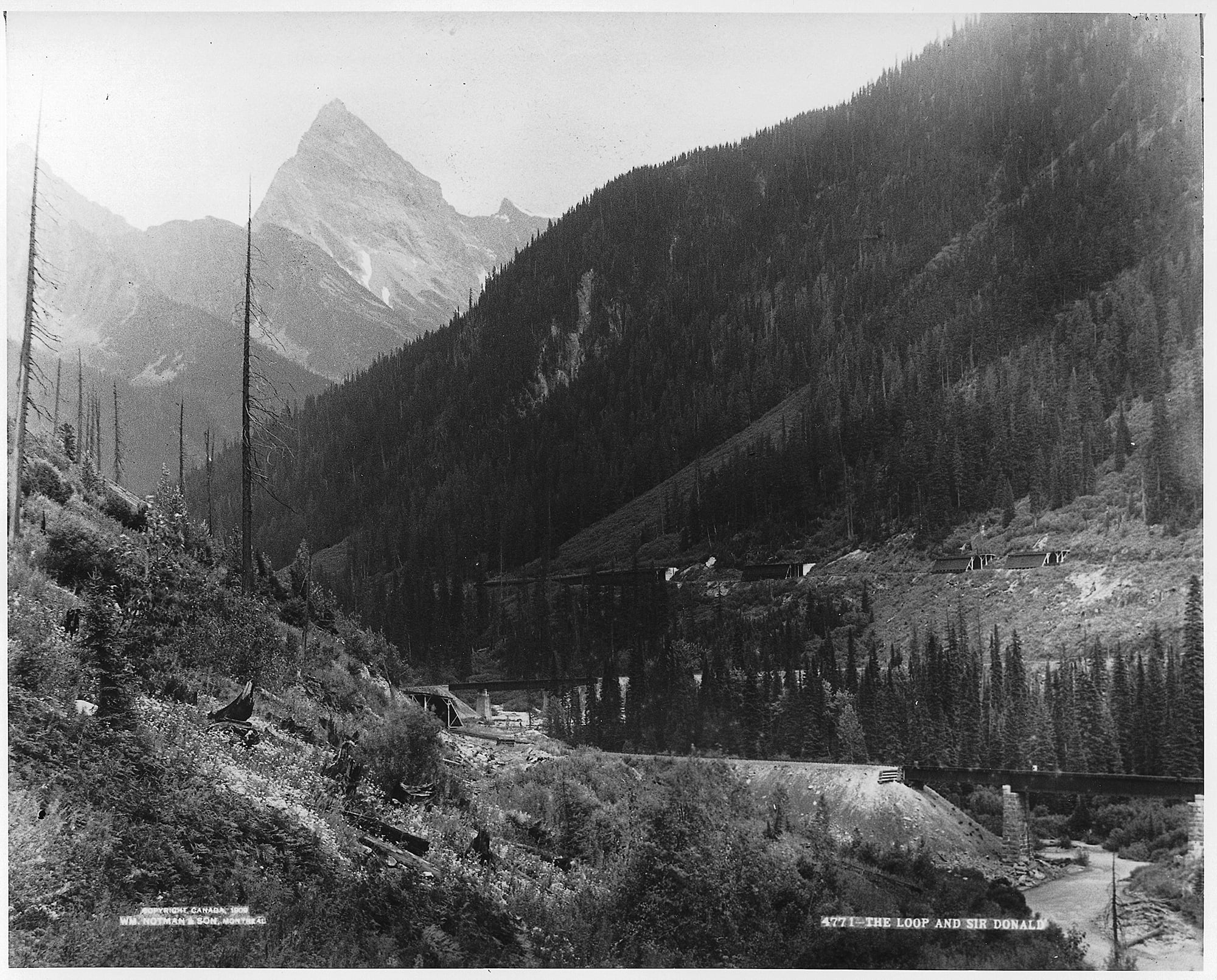
Notman 4: Notman 1909 photo ‘The Loop and [Mount] Sir Donald’. Here the famed S-bend is pronounced. The facility upgrades painted by Jacquiard in his second scene are in place. On the upper slope nearing Glacier House (yet still out of sight), stand snowsheds nos. 24 to 27. McCord Stewart Museum, Montréal, VIEW-4771.
Robert D Turner
(1947– )
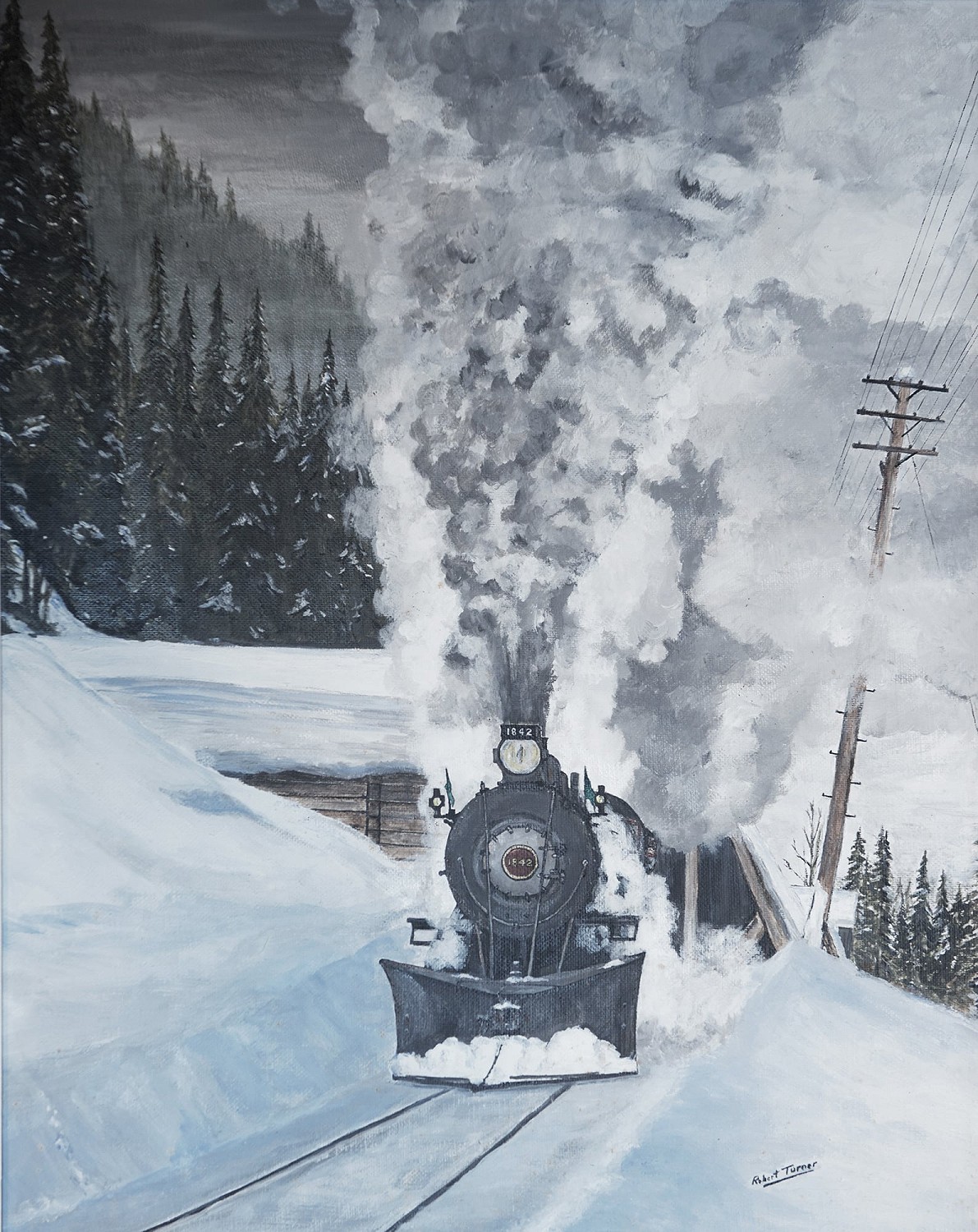
‘Winter in the Selkirk Mountains’. Inspired by a Caple photograph (shown below), RD Turner brings CP 1842 forward like a cinder in your eye. See position ⑥ on the map. This image graces the cover of his book West of the Great Divide (1987). Reproduced with permission of the artist.
Bob Turner is the only living artist discussed here. A lifelong British Columbian, he is internationally respected as a historian of steam transportation and has authored 20 books.
He has painted only four railway scenes, all for his own publications. The scene shown depicts CP 1842 working upgrade near Glacier House at snowshed no. 21. Like Jacquiard, Turner rarely includes railway workers.
Turner knew Jacquiard personally and reproduced several of his works. His painting style is realistic, nostalgic, and informed by period photography. Two winter scenes demonstrate a sophisticated understanding of snow’s chromatic complexity.
Notably, Van Horne discouraged winter imagery in CPR publicity; by the time Turner painted, such constraints no longer applied.
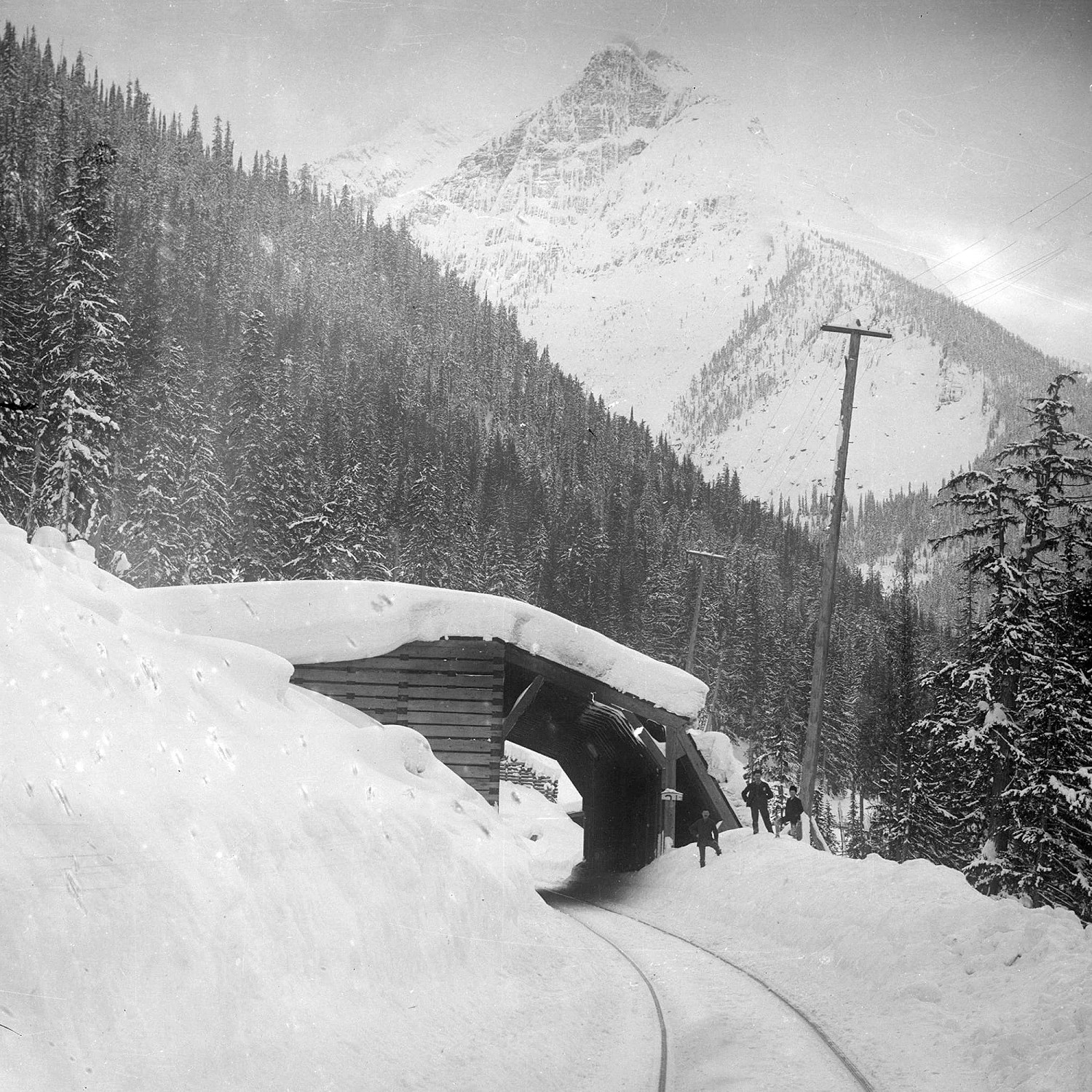
Snowshed no. 21 with Ross Peak behind, position ⑥ on the map. Compare this with Turner’s painting. This was the first snowshed encountered downgrade from Glacier House. Photo by Norman Caple, circa 1895. City of Vancouver Archives AM54-S4-: LGN 755.
Jim Finnell
(1944–1994)
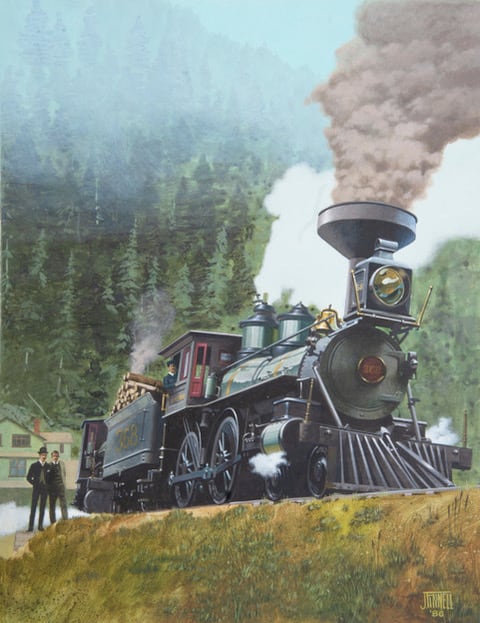
‘Atlantic Express, Glacier House’ – J Finnell’s 1986 rendition of an 1887 meal stop in the Selkirk Mountains. By the time this painting was composed, not a single rusted bolt or rotted board remained to guide the artist. Finnell worked entirely from a family photograph taken a century earlier. The original hand-colouring was very likely done by Mary Vaux, a recognized botanical artist.
Jim Finnell may be the most widely recognised artist here, despite never visiting the location he painted. Raised in a military family, he later worked in commercial illustration before founding Durango Press.
His steam-era railway paintings appeared frequently on the cover of Narrow Gauge and Short Line Gazette. Bob Turner commissioned Finnell to paint a Glacier House scene based on an 1887 hand-tinted Vaux family photograph—the only known Canadian subject in Finnell’s work.
Finnell’s locomotive, a cordwood-burning 4-4-0, is rendered with characteristic vitality. His legacy endures through collectors and continued auction sales.
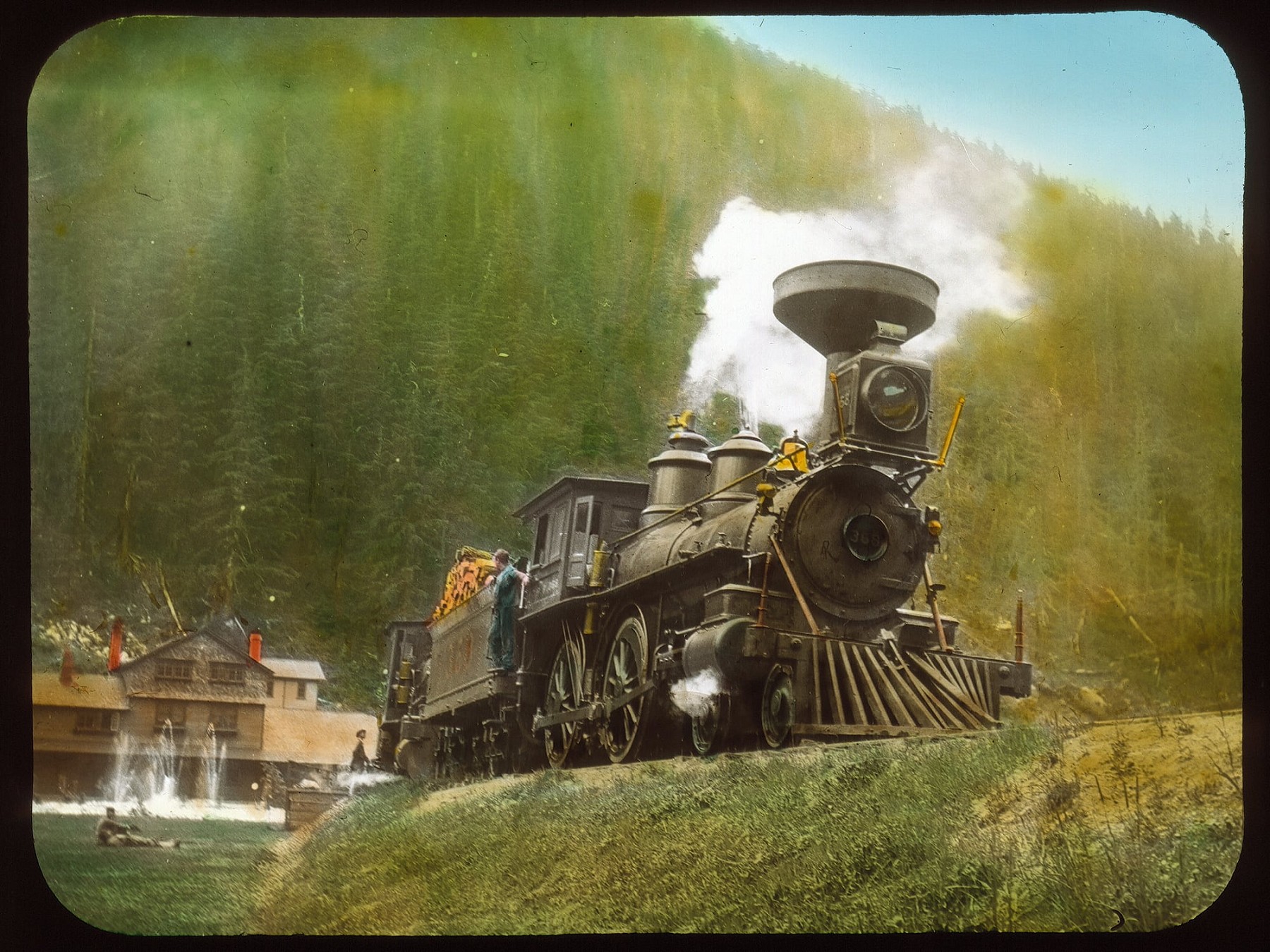
Among the guests at Glacier House in July 1887 were George, William, and Mary Vaux—Philadelphia Quakers whose names, photographs, and research became synonymous with the area. This well-composed image so perfectly captures the time, place, and mood of that moment that J Finnell composed his iteration almost exactly the same, 99 years later. See position ⑦ on the map. Credit: Whyte Museum of the Canadian Rockies, v653 ps 4.z.
Conclusion
These artists were not merely recording a railway; they interpreted a frontier, shaping perceptions of Canada’s western mountains for domestic and international audiences. Through varied media, they captured both engineering achievement and landscape myth.
By coincidence, just three miles of track between Glacier House and Cambie attracted all six artists discussed here. Others exist, omitted only because images could not be obtained.
For more than a century, such works defined the visual identity of Canada’s railways. They remain historical documents, artistic achievements, and cultural artefacts, ensuring that the CPR endures not only as an engineering triumph but as a source of artistic inspiration.
Further Reading
Tom Parkin has won four media awards through the Canadian Railroad Historical Association’s annual awards (2018, 2020, 2022, and 2023). Readers wishing to track his other stories, or to suggest article ideas, may contact him through this website.
Boulet, Roger, 2009. Vistas: Artists on the Canadian Pacific Railway. Glenbow Museum, Calgary, AB. Including over 120 images, this book supplemented an exhibit of the same name.
Pringle, Donald Allan, 1983. Artists of the Canadian Pacific Railroad: 1881-1900 (view PDF). Concordia University Masters thesis. A thorough academic treatise with details mostly of interest to art researchers.
Sanford, Barrie, 2012. Train Master: The Railway Art of Max Jacquiard. National Railway Historical Society, Vancouver, BC. A coffee table book with alternating pages of paintings with detailed captions, chaptered by mountain range; 164 pages.
Did You Enjoy This Article?
Sign Up for More!
“The Parkin Lot” is an email newsletter that I publish occasionally for like-minded readers, fellow photographers and writers, amateur historians, publishers, and railfans. If you enjoyed this article, you’ll enjoy The Parkin Lot.
I’d love to have you on board – click below to sign up!