
Old Glacier House, Episode 1 Once a Famed CPR Mountain Hotel
My grandfather Hugh McNeil emigrated to Canada from the Hebrides, a rugged archipelago off the west coast of Scotland. He left alone at the age of 21, after his older brother inherited the family croft, in accordance with the custom of the day. Hugh sailed for Canada in search of a new life.
His fortune turned when he was casually offered an opportunity by Lord Strathcona, the former Donald Smith, one of Canada’s wealthiest men and Chairman of the Canadian Pacific Railway. Strathcona had acquired the Isle of Colonsay, where the McNeils lived, after its previous owner could no longer keep up with mortgage payments.1
Hugh was obliged to leave, but his emigration established his descendants—including me—as Canadians. It was he who initiated my family’s connection to today’s Canadian Pacific Kansas City. Railroading was my father’s career as well, beginning in the CPR shops in Cranbrook, BC, in 1928.2 He later married my mother, Hugh’s Canadian-born daughter.
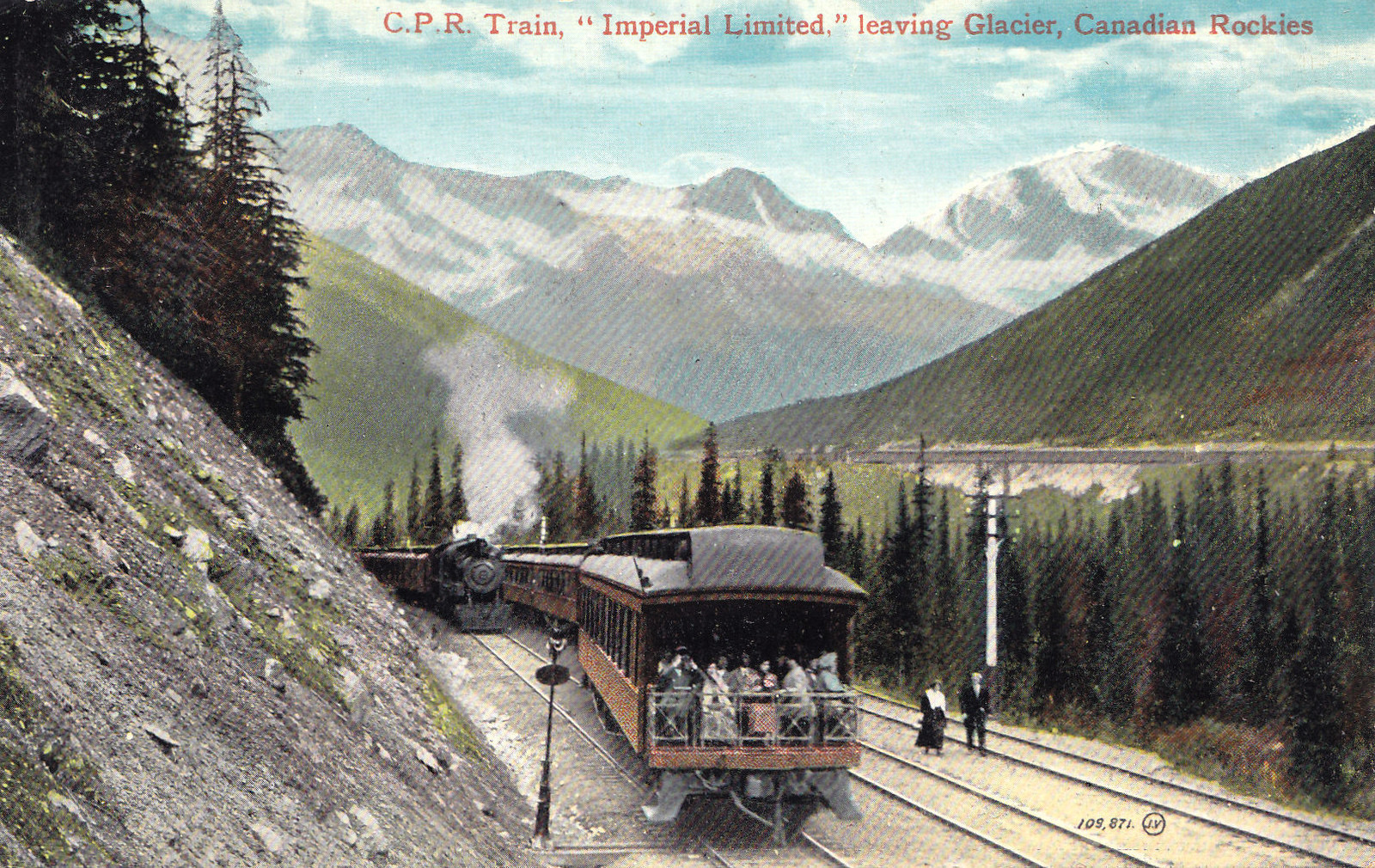
Postcards became de rigueur in the early 1900s, competing with the first Kodak portable cameras. Here, the Imperial Limited departs for Vancouver as an inbound passenger train waits its turn at the platform. On the opposite mountain slope, a long line of snowsheds is visible. This hand-tinted card was published by Valentine & Sons, Montréal and Toronto.
Hugh didn’t just cross an ocean; he transitioned to working in the ‘running trades’ of the railway after his arrival. His story of perseverance and adaptability runs through generations. My mother, proud of her father’s journey, convinced him to record his memories on reel-to-reel tape. She then transcribed and organized his stories into a series of episodes. Though never published, the manuscript remains a cherished family heirloom. When both my parents passed in 1987, I became its custodian.
Hugh didn’t just cross an ocean; he transitioned to working in the ‘running trades’ of the railway after his arrival.
Now, as a rail historian myself, I’m pleased to offer
you Hugh’s account of his arrival in BC’s Selkirk Mountains—specifically
at Rogers Pass in 1903. The accompanying photos come from postcards
commonly sold at that time. Hugh would have acquired them as mementos of
his experiences. I’ve added captions for each from my own knowledge of
the area.
Hugh begins by describing his first sight of Glacier House, a hotel built in 1886 to accommodate tourists captivated by the region's alpine beauty. Soon to become a world-renowned destination for mountaineers, Glacier House hosted many famous guests. Hugh arrived not as a tourist or guest, but as a stonemason, hired by the CPR to work on bridge piers at nearby Cambie siding.
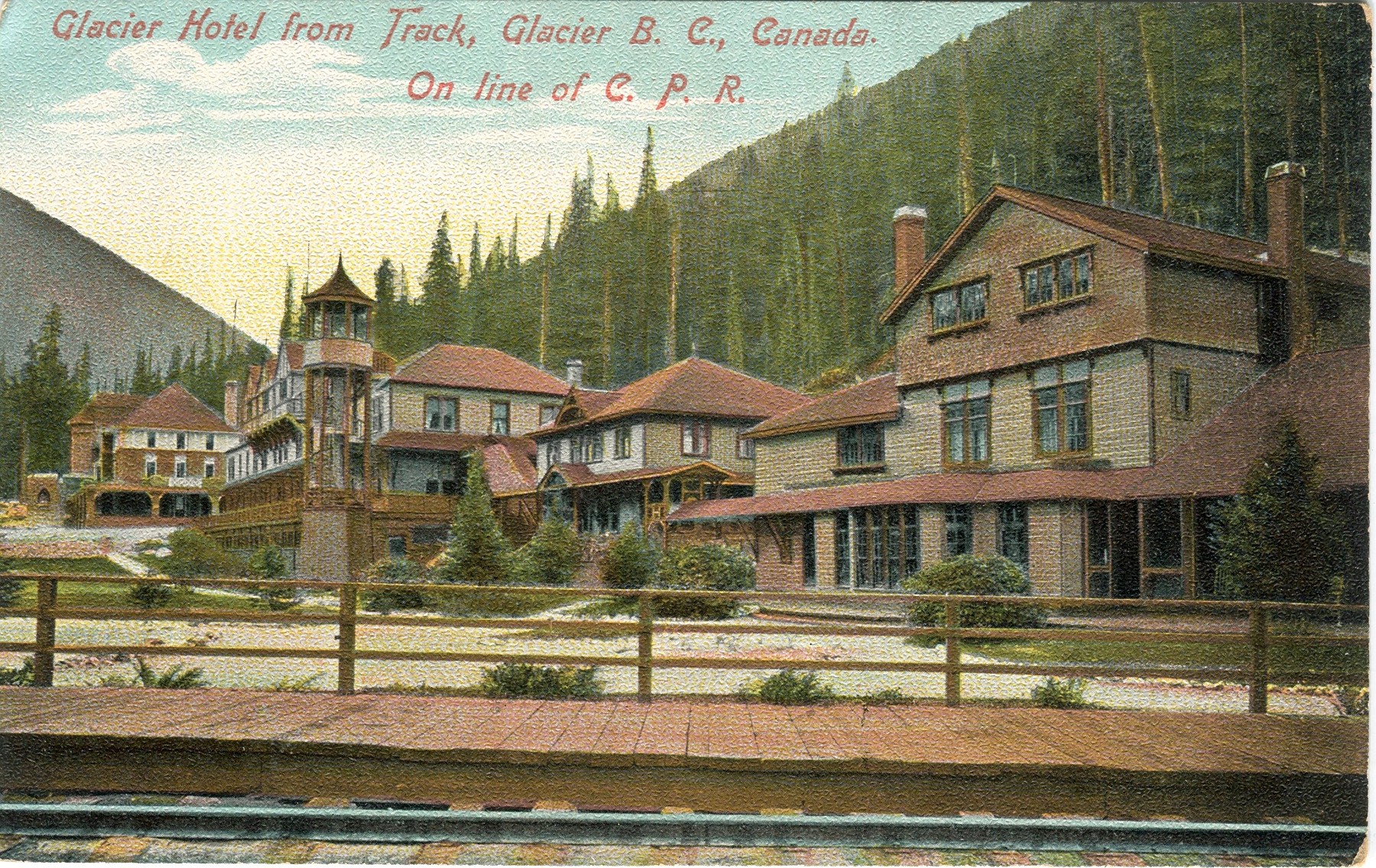
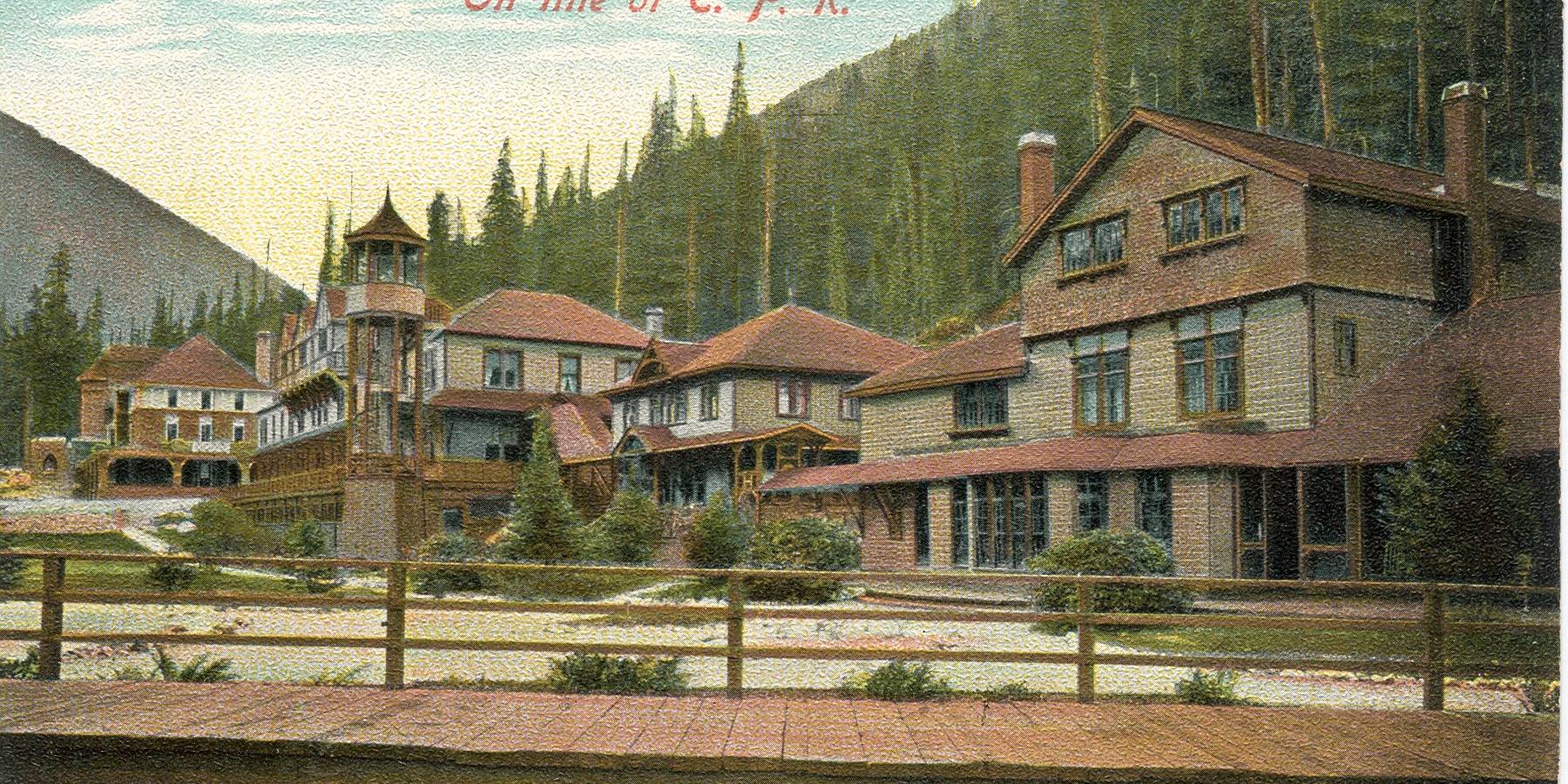
Since urban postcard painters had no idea what colour the hotel really was, they chose their own palette. Written descriptions record Glacier House as mustard-coloured—at least for a time. The observation tower had a telescope, allowing guests to examine surrounding peaks and perhaps spot mountaineers climbing them. Circa 1904.
The Autobiography of Hugh McNeil
I’ve oft been asked what it was like when I first came into this country. With some reluctance, I tell here what seems to be an ordinary immigrant’s story. It’s been decades since it happened, so family members be warned! This is naught but an old man’s tale at a time when everything was very new and I barely took note of the details which history requires. I got by, for certain, with a modicum of luck more than good planning. So this isn’t any kind of guide for other Scots wanting to come to Canada. Nay, it can’t even be said to be a typical experience. My family feels differently, so I tell ye how I arrived at Glacier House, the CPR hotel in Rogers Pass. Here in BC.3
We were all stinky, cranky from lack of sleep, and overwhelmed by the frequent bickering in foreign languages.
I’d come ’cross the whole country by train direct from Montréal, in a colonist coach. I had a letter of introduction from some senior engineer at CPR headquarters in Windsor Station (I don’t recall his name). Aye, that was about all I knew. I had a steamer trunk with clothes, books, and basic hand tools in the baggage car, but got by for five days with a simple carpet bag in the coach I shared with others watching their pence.4
We were all stinky, cranky from lack of sleep, and overwhelmed by the frequent bickering in foreign languages. I didnae suppose any of us knew what to expect. My ticket for passage told me to get off at Glacier House and my letter told me I was to be met by a company representative who’d take me to a bridge gang working at a place called Cambie.
We were on a distinct downgrade after crossing the summit of Rogers Pass. Our train bent gently like a horseshoe across the mouth of a small side valley, slowing to a standstill alongside a parallel wooden platform. Virtually everyone rose in order to detrain. Since leaving Calgary that morning, my anxiety had been eased by the chance encounter of a seatmate, Charles Deutchmann. He looked like one of those mountain men portrayed on so many American calendars, but was friendly enough. He said his nickname was “Old Griz” and that he was just starting his season of prospecting.5
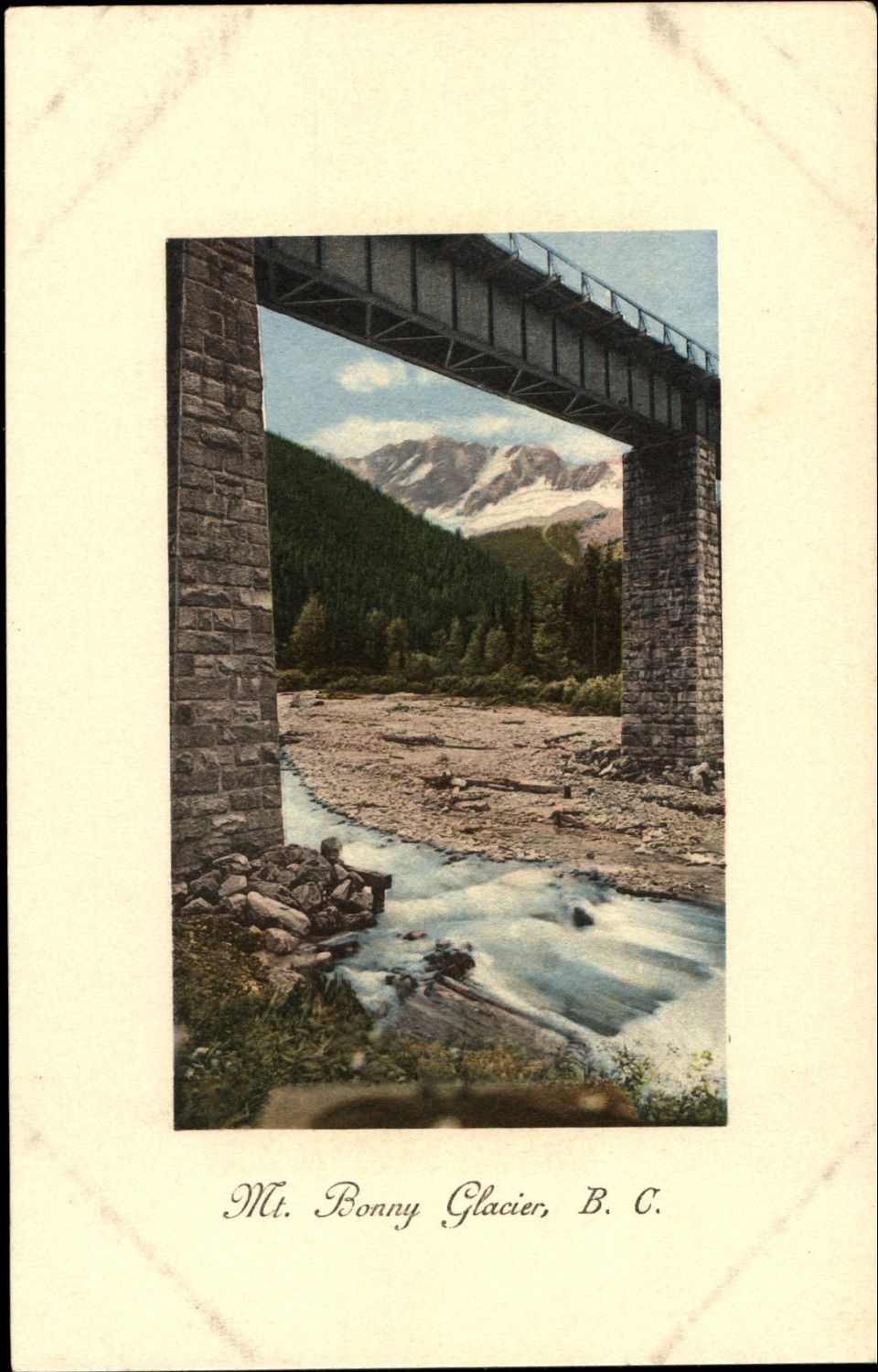
This bridge at nearby Cambie was where Hugh went to work. The photo was taken by Sidney Baker, who also offered pony rides from the hotel corral. He and his wife were summer residents. Mrs Baker sold fancy goods and curios to guests from a shop on the grounds. He marketed his postcards in competition with larger companies with a greater selection of views.
“This is where we must part, my friend,” he said. “I’m going to the next stop to establish operations for the year. You’ll find a lunch counter here, inside the hotel. I’ve got myself some bierwurst, and have to visit a wrangler friend over at the stables.”
We got off together and shook hands on the platform. I thanked him for his ‘tour’.
“Oh, think nothing of it. I’d do the same for a white man!” He laughed at his own joke. I gathered this was his way of marking friendly regard, though the words initially seemed coarse. I hadn’t thought I stood out much, but this was another of the strange customs I learned early in this country—where a man affirmed pleasure in another’s company through gratuitous insult.
“We’ll likely cross paths again. Come down to Illecillewaet to visit if they ever give you a day off.” As I came to learn, Deutchmann was a man never happily employed for wages.
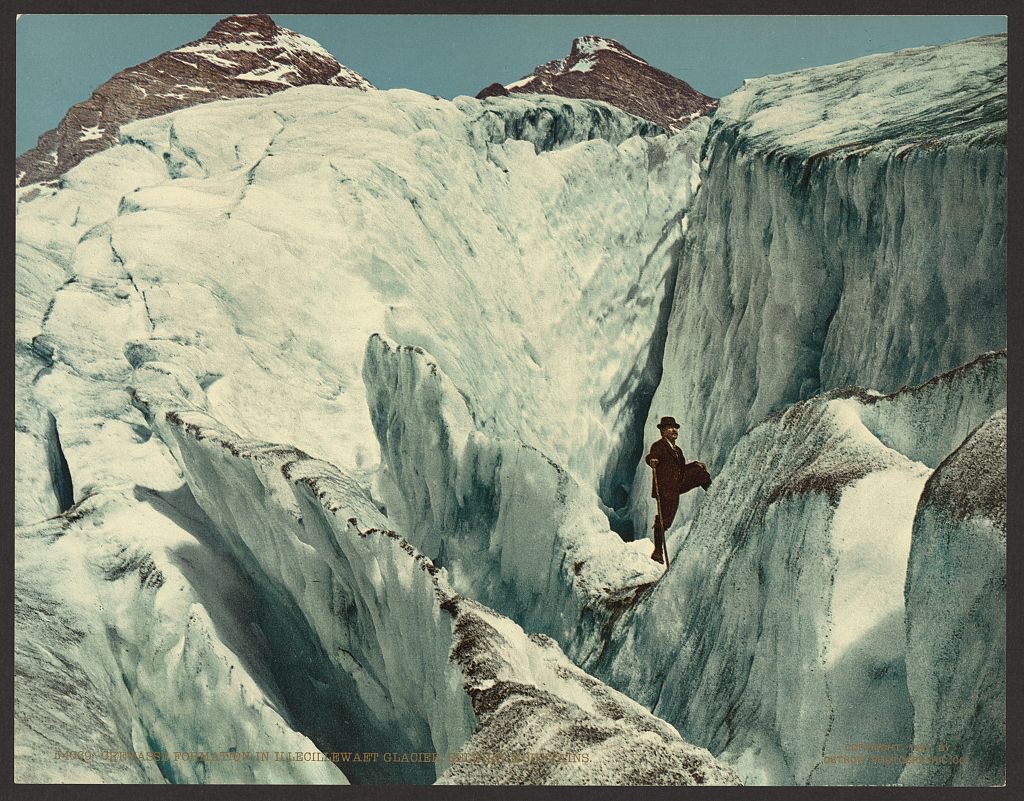
Many, if not most, hotel guests hiked up the valley to touch the icy toe of the Great Glacier—later named the Illecillewaet Glacier. Mount Sir Donald, rising behind this unroped Swiss guide, reaches a summit elevation of 3,284 metres (10,774 feet). This postcard was published in Detroit in 1902.
It wasn’t yet summer, but the platform was busy. The disembarking crowd headed toward the nearest building. This was Glacier House, better known than the summit of the historic pass itself. I paused along the railing to take it in. The first class crowd from the last coaches had become rather chummy and were chattering as they proceeded. The Americans busied themselves with their new-fangled contraptions—“Kodaking”. That’s what we called cameras and photography in those days. I didn’t have a camera, but postcards were sold, so I collected those instead.
The hotel was built to resemble an Alps chalet, mainly because its wide eaves kept snow off the walkways. The foremost structure was fronted by wide plank walkways which also extended along the track to a small station and telegraph office. Other buildings had been added perpendicularly, up-valley from the track, all connected by breezeways and verandas for weather protection. On the lawn was a low, semi-circular mound of railway ties heaped over with soil and grass. It had a single entrance to a dark interior such as igloos had been described to me.
“There’s a bear!” rang a warning from the leaders of our horde. I heard another guffaw from Deutchmann, invisible in the distance. He evidently knew what to expect. Outside its den, chained to a much-clawed post, was a black bear. This poor beast was the object of derision, from both Kodakers and young men, who gave young ladies thrills by strutting within the limit of the animal’s circular leash. A sort of game soon developed by which these dandies teased the animal by parading just beyond the arc of its reach, winding its chain tighter around the post.
At that moment an unexpected roar came to our ears, something like distant thunder, only sounding continuously. We looked up. Within the cirque of surrounding summits, people now excitedly pointed at a cascade of snow, flowing like white water down a steep slope of bedrock. We had already missed a good part of it by the time the sound travelled to us, and it disappeared behind the intervening tops of hemlocks and spruce. That was my first avalanche.
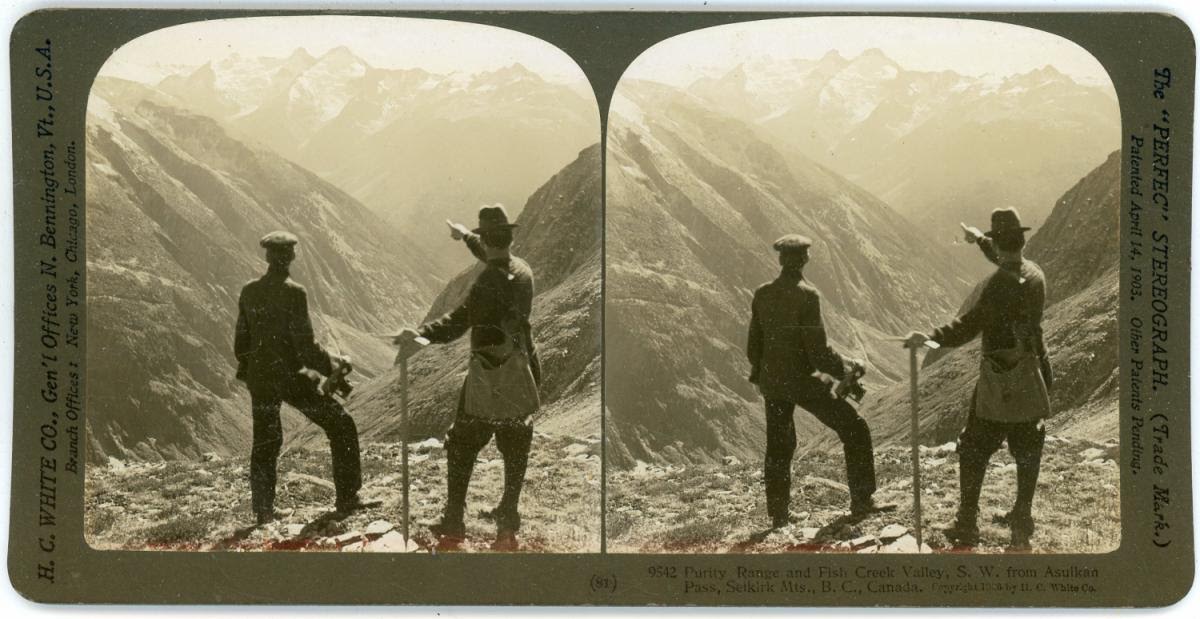
This double image is a stereoscopic card. When viewed through a handheld stereoscope, the paired photographs merge into a single three-dimensional scene. The caption reads “Purity Range and Fish Creek Valley, S.W. from Asulkan Pass.” The Tyrolean hat was a trademark of CPR Swiss guides. They served at four of the mountain hotels, initially charging $5 per day.
The aggravated bear saw opportunity during this pause. With a roar of his own, he ran counter-clockwise, unravelling his chain, attempting vengeance on his tormenters. Feminine shrieks turned to screams as their beaus backed away for safety. No one was snagged by the pant leg, and it all ended with the women scolding “I told you so,” and the men chortling over their near miss. I took note of the animal’s cleverness and speed. It would be dangerous as a wild adversary.
Entertainment over, the chatterers filed into the dining room for lunch. I continued to take in the scene. Signposts along the platform railing pointed to the surrounding features: the Hermit Range; Grizzly Mtn, 9,045 ft.; Swiss Peak, 10,482 ft.; the Great Glacier, (½ mile distant by trail); and Mount Sir Donald! Astoundingly, here was my benefactor again, only larger than life, towering a mile and a quarter above the track. Later I learned it had been shaped by the Ice Age into a Canadian Matterhorn. It’s fitting thanks for the man’s service to the company, to the country, and in a place where many came to know his good name.6 Ye do ken that he drove the last spike at Craigellachie?
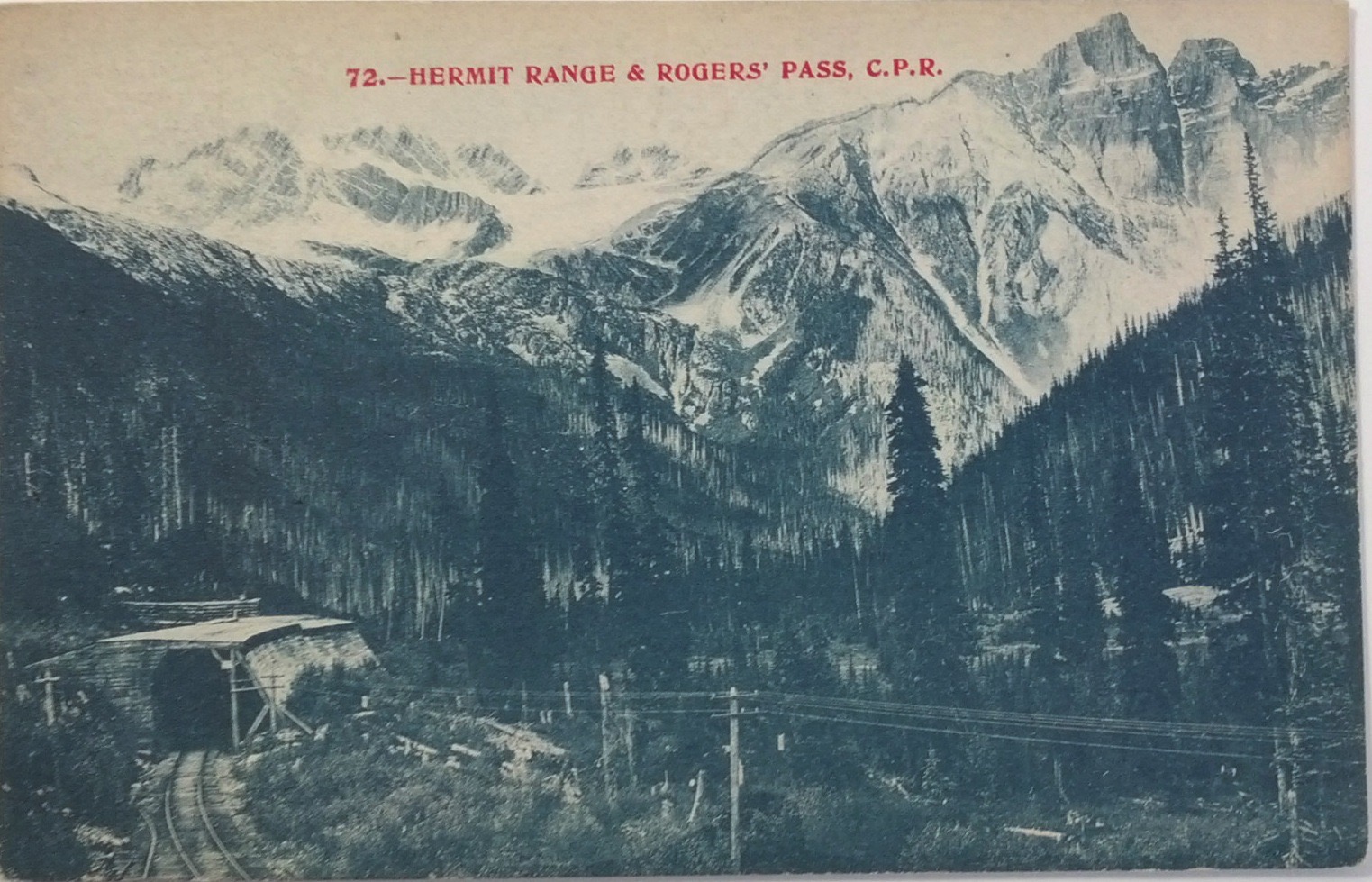
This photo postcard shows the view in Rogers Pass. The photographer not only wanted purchasers to recognise the scene from the hotel, but also knew what travellers wanted to show their friends by post. At this time, one penny would send a postcard across Canada.
Within weeks I came to learn that upstanding face put an itch into the boots of mountaineers. To climb this spire, and a hundred others in the area around, was the goal of many guests of Glacier House. It was the sport for the better kind of people in those days. They came from all over Europe to see, and to ascend. At the time of my arrival, many peaks were still unnamed. Such peaks were called “virgin”; as, I suppose, Sir Donald had been before he was surmounted in 1890. [Mom notes choking laughter here, as if Hugh had inhaled his pipe smoke].
To enable this sport, and for its own good, of course, the CPR began bringing climbing guides from Switzerland each spring. Four were assigned to Glacier House soon after I showed up. Custom required they meet each passenger train as a way of advertising their service. Thus I noted them spaced along the boardwalk, a coiled rope over one shoulder and a long-shafted ice axe in hand. They were subjected to as much Kodaking as the bear because people wanted to stand beside them. As I later came to know them, the Swiss considered themselves professionals, and played the role better than some gentlemen who visited Glacier House. The guides were rarely seen without a necktie and wore tweed jackets even when climbing. They set a fashion trend with their knickerbockers and puttees which even the fairer sex came to adopt. I thought it silly. A woman wearing pants?
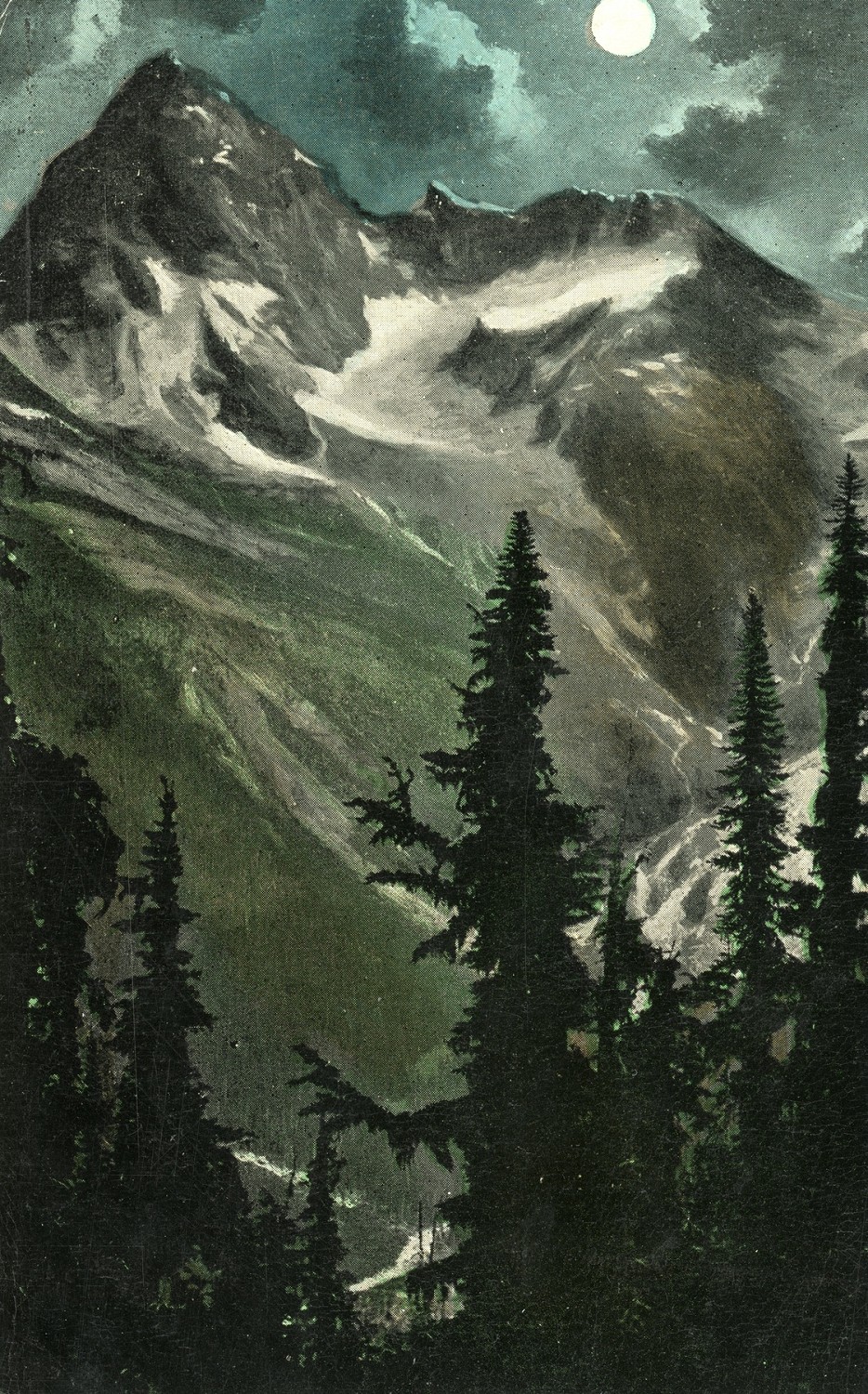
To look distinctive on a crowded rack of offerings, postcard publishers often created subtle illusions such as this fake night scene. Mount Sir Donald is shown in moonlight at a time when cameras were incapable of capturing dark vistas.
The hotel had two rooms for dining, between which passengers separated themselves by class of coach fare. Silver service was available for first class. Ye know—white linen, wildflower bouquets, waiters in bowties—not my league. I entered the stand-up lunch counter with others from my colonist coach, most anxious about spending their diminishing dollars, myself included. If no one showed soon to engage me, I had no notion what to do next.
The last passengers hurried back to the train. No one had presented himself on behalf of my employer, so I thought it best to wait on the platform, where I’d be obvious to whomever was supposed to meet me. I followed the deck around to the station, where my trunk waited under its broad eaves. To check whether there might be a message, I pushed open the door to the telegraph office. Judging by the open canvas bags, the station agent was in the process of sorting mail and express, both of which had arrived on my train’s baggage car. A bundle of newspapers wrapped with twine was cut open, and he was concentrating on the uppermost page. Its headline read:
Earthquake, Explosion, and Flood, Engulf Town of Frank, N.W.T.7
A WHOLE MOUNTAIN TOP SHATTERED BY VOLCANIC ACTION —
FALLING DEBRIS ENTOMBED PART OF THE TOWN COVERING MEN,
WOMEN AND CHILDREN. —A HUNDRED LIVES REPORTED LOST.—
ERUPTION STILL CONTINUES. —TOWNSITE COVERED BY WATER —
INHABITANTS FLEE TO THE HILLS.
Endnotes
- John De Vere Lodor, Colonsay and Oronsay in the Isles of Argyll, Colonsay Press, 1995; (originally published 1935), page 188.
- Seniority of Firemen list, CPR BC District, revised January 1, 1948.
- William L Putnam, The Great Glacier and its House, American Alpine Club, 1982, 223 pages.
- https://en.wikipedia.org/wiki/Carpet_bag
- https://en.wikipedia.org/wiki/Nakimu_Caves
- https://en.wikipedia.org/wiki/Mount_Sir_Donald
- This actual headline is from a clipping left between pages of Hugh’s transcription. Also see: https://en.wikipedia.org/wiki/Frank_Slide.
Did You Enjoy This Article?
Sign Up for More!
“The Parkin Lot” is an email newsletter that I publish occasionally for like-minded readers, fellow photographers and writers, amateur historians, publishers, and railfans. If you enjoyed this article, you’ll enjoy The Parkin Lot.
I’d love to have you on board – click below to sign up!